By Desire Uzochukwu
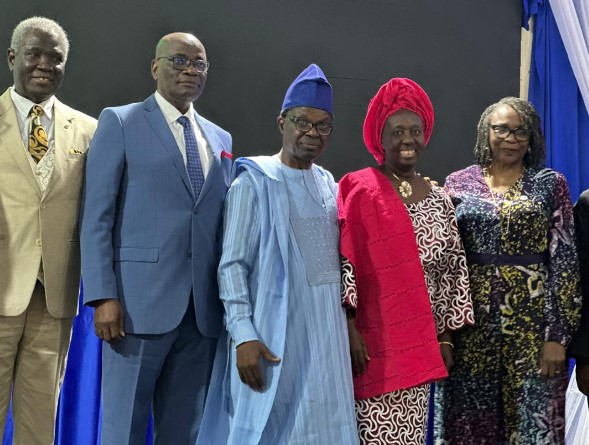
After 44 years in academic medicine, Professor Olugbenga Abayomi Okanlawon is retiring from the College of Medicine, University of Lagos, CMUL, leaving behind a career that combined anatomy, reproductive biology research and the training of generations of medical scholars.
Okanlawon, who retires on September 16, began his academic journey as a medical student who distinguished himself in Anatomy before becoming a professor, researcher, academic administrator and mentor.
His contribution to reproductive biology and endocrinology, colleagues said, helped strengthen research and postgraduate training in the field, while his mentorship produced scholars now working in Nigeria and abroad.
These contributions came under the spotlight at his valedictory lecture, titled “Beyond Anatomy: Custodian of Memory, Maker of Scholars, Builder of Institutions.”
Delivering the lecture, the Dean, School of Postgraduate Studies, University of Lagos, Professor Abraham Osinubi, said Okanlawon’s greatest contribution could not be measured only by publications, citations or academic positions.
Rather, he said, the real measure of an academic career is what remains after the scholar leaves — the people trained, knowledge transferred, institutions strengthened and values passed to succeeding generations.
Osinubi, who supervised Okanlawon’s master’s and doctoral degrees, said: “The greatest supervisor is the one who eventually becomes unnecessary because the goal of supervision is intellectual independence.”
He described Okanlawon’s legacy using what he called the “4M Legacy Model” — memory, mentorship, multiplication and mission.
“Legacy is not just about buildings. Legacy is more about building people. How many people have you lifted up?” Osinubi asked.
He added: “A position is what you occupy; a legacy is what you build. A title gives you authority. What you develop gives you influence. A building can carry your name, but only people can carry your values.”
Okanlawon’s interest in Anatomy dates back to 1977, when he obtained a distinction in the subject, one of only two students to achieve the feat.
The following year, he became a student demonstrator, teaching junior medical students at a time when the department had few lecturers. He taught students from the third to fifth year and was paid six naira per hour.
After his medical training and NYSC, he joined the Department of Anatomy in 1982 and rose to become Professor of Anatomy in 2003.
His research career subsequently focused on reproductive biology and endocrinology, including androgen regulation, spermatogenesis, testicular function, reproductive toxicology, environmental toxins, herbs and drugs, and reproductive health.
He has published more than 60 scholarly papers and supervised over 15 PhD candidates.
Head of the Department of Anatomy, Professor Olufunke Dosumu, described Okanlawon as an academic father whose mentorship shaped many young researchers.
Dosumu recalled joining the department as a postgraduate student in 1999 and said Okanlawon guided her through her early research career, including helping her produce her first publication.
She said he played an important role in developing reproductive biology and endocrinology at the department, while his work in stereology created another area of research strength.
Professor Stella Gbotolorun also described Okanlawon as a mentor who deliberately groomed younger researchers and a valuable source of institutional knowledge.
That institutional memory became another major scholarly contribution of the retiring professor.
For nine years, Okanlawon documented the history of the University of Lagos on a weekly basis, recording major events, personalities, administrations, crises and institutional milestones.
The effort resulted in a three-volume book, “Discovering the University of Lagos: One Day at a Time,” formally unveiled on September 1.
Vice-Chancellor, UNILAG, Professor Folasade Ogunsola, described Okanlawon as a “historian anatomist” and urged him to continue writing after retirement.
“If not UNILAG, then Nigeria,” she said.
Provost of CMUL, Professor Ademola Ayodele-Oremosu, said the College would miss Okanlawon’s experience, institutional knowledge, teaching, research, mentorship and contribution to postgraduate training.
“You cannot buy experience in the market,” he said.
For Okanlawon, however, his commitment to mentorship was rooted in his own experience.
He traced it to his mentor, Professor Oladapo Ashiru, saying the support he received created a responsibility to support others.
“I had people who mentored me, so I can mentor others,” he said.
“Once you experience help, it is your duty to make sure that you help others too. And once you do that, the cycle continues from one generation to another.”
As he retires, Okanlawon leaves behind not only decades of anatomical and reproductive health research, but also a network of scholars carrying forward the knowledge and values he helped build.
For a discipline whose purpose is to understand the structure of the human body, his academic career has ultimately demonstrated another kind of anatomy — the structure of a profession sustained through knowledge, mentorship and the people who carry it forward.