By Destiny Obinna
The Indigenous Igbo Congress (IIC), Rivers State, has urged the Federal Government to ensure fairness and respect for historical and cultural identities in any restructuring of Nigeria, warning against any arrangement that would, in its view, fragment Igbo communities.
The group specifically demanded the recognition of what it described as a single and undivided Igbo region, including Igbo-speaking communities in Rivers State and other parts of the country, in any future political or constitutional restructuring.
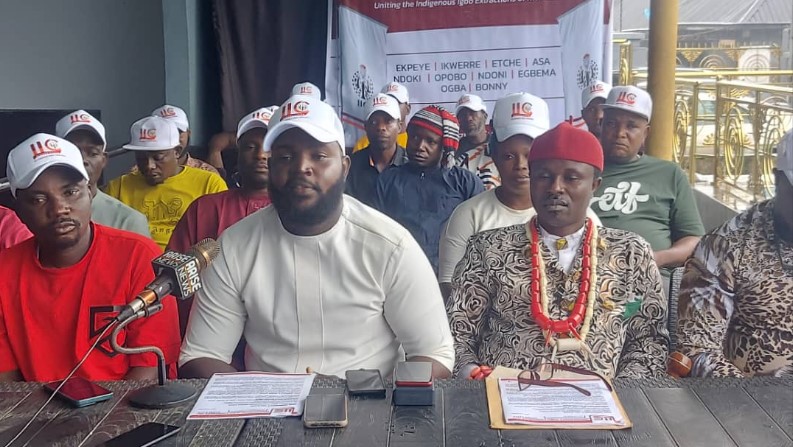
The IIC made its position known in Port Harcourt while presenting its submission on the ongoing restructuring debate under the aegis of the Concerned Citizens Assembly.
Reading the group’s position, its Vice-President, Comrade Azubuike Okere (Ndoki), said restructuring could only achieve its objective if it was anchored on fairness, historical responsibility and respect for the legitimate interests of indigenous communities.
Okere specifically identified Ekpeye, Ikwerre, Etche, Asa-Ndoki, Opobo, Ndoni, Egbema, Ogba and Bonny communities as areas whose historical and cultural ties, according to the IIC, should not be severed by any restructuring arrangement.
“We have taken careful note of the ongoing discussions and proposals concerning a possible national restructuring of Nigeria and the several models being advanced for the political and administrative reorganisation of the Federation,” he said.
The IIC Vice-President said the group welcomed genuine efforts to address Nigeria’s political, economic, constitutional and structural challenges, but cautioned that restructuring must not become a vehicle for what it regarded as the arbitrary division of indigenous communities.
According to him, restructuring should be approached with “historical responsibility, constitutional fairness, and respect for the legitimate interests of indigenous communities.”
He argued that the present boundaries of states and local government areas should not automatically be regarded as the permanent boundaries of indigenous identities, ancestral territories and cultural communities.
“The administrative arrangements, drawn and redrawn by proclamations, decrees and gazettes, must not, therefore, be automatically treated as the immutable boundaries of indigenous identities, ancestral territories, historical relationships or cultural communities,” Okere said.
He urged the Federal Government, political leaders, traditional institutions, civil society organisations, ethnic and cultural groups and other stakeholders participating in the restructuring debate to ensure that indigenous communities were not arbitrarily divided in the process.
Also speaking, the President-General of the IIC, Comrade Chimenum Amadi, rejected any restructuring proposal that, in the group’s assessment, would dismember Igbo communities in Rivers State.
Amadi urged Igbo leaders across the country to remain vigilant and participate actively in discussions on the future political structure of Nigeria.
He said the future of Nigeria should be determined through inclusive dialogue and negotiation rather than through arrangements imposed on any section of the country.
The IIC maintained that a credible restructuring process must take into account the historical relationships, cultural identities and interests of indigenous communities while addressing the broader political and structural challenges confronting Nigeria.