By Desire Uzochukwu
The United Nations Children’s Fund (UNICEF) has expanded its digital education drive to Oyo State, targeting children and teachers in rural and underserved communities as the state becomes the 26th in Nigeria to adopt the Nigeria Learning Passport.
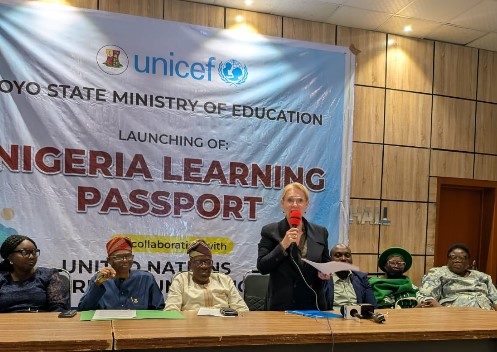
The digital learning platform, which already has about 2.4 million children and teachers using it nationwide, was formally launched in Oyo on Wednesday at the Local Government Hall, Secretariat, Ibadan.
UNICEF Lagos Chief of Field Office, Celine Lafoucriere, said the expansion was aimed at ensuring that children facing barriers to conventional education could access quality learning opportunities through technology.
She said the platform offered thousands of curriculum-aligned lessons in Mathematics, English and Science, accessible through phones and tablets both online and offline.
“We see the recruitment of 5,000 teachers by the Oyo State Government as an opportunity to strengthen classroom learning through the Nigeria Learning Passport,” Lafoucriere said.
She commended the state government for its investment in education, but urged it to ensure that the benefits of digital learning extended beyond urban centres to communities where electricity, internet connectivity and access to digital devices remained limited.
According to her, girls and children in underserved communities should receive particular attention as the state rolls out the initiative.
“We must deliberately extend this initiative to rural and underserved communities, particularly girls,” she said.
“Children in areas with limited electricity and network coverage should not be left behind in accessing digital learning opportunities.”
2.4m Already Using Platform
Lafoucriere explained that the Nigeria Learning Passport was initially developed in response to the disruption caused by the COVID-19 pandemic, when school closures affected more than 1.6 billion children globally.
The platform enabled children to continue learning through mobile phones, radio and other channels, including in communities with limited or no internet connectivity.
She said the initiative had since evolved from an emergency response into a broader education tool designed to strengthen learning opportunities and build resilience within education systems.
The UNICEF official said the platform was being implemented through collaboration between UNICEF, the Federal Government, development partners and private-sector organisations.
She identified Microsoft as the technology platform developer, the Global Partnership for Education as a financial supporter, IHS Towers as the connectivity infrastructure partner, TECNO as the device provider and Airtel as the data partner.

According to her, Airtel’s partnership means users can access the platform without bearing the cost of data usage.
UNICEF Wants Teachers at Centre
Lafoucriere said the effectiveness of the programme in Oyo would depend significantly on how well teachers were trained and supported to integrate digital resources into classroom teaching.
She urged the state government to leverage the recruitment of 5,000 teachers by ensuring that newly recruited personnel were adequately trained to use the platform.
“Our newly recruited teachers should be equipped with the knowledge and support required to integrate the platform into classroom teaching,” she said.
She explained that UNICEF’s role included ensuring that learning content aligned with the Nigerian curriculum, was available in languages children could understand and was complemented by teacher training.
Beyond Registration Figures
Lafoucriere also cautioned against measuring the success of the initiative solely by the number of people registered on the platform.
She urged the state government to track actual usage and learning outcomes to determine whether the digital intervention was improving educational outcomes.
“We should track not only registrations but actual usage and learning outcomes,” she said.
She said monitoring should establish whether children were actively using the platform, whether their learning outcomes were improving and whether challenges relating to connectivity, devices and data access were being addressed.
According to Lafoucriere, the ultimate test of the initiative would be its impact on children across Oyo State, including those in communities such as Saki and Iseyin.
“The real measure of this initiative’s success will be its impact on children across Oyo State, including those in communities such as Saki and Iseyin,” she said.
She expressed UNICEF’s appreciation to the Oyo State Government, teachers, development partners and other stakeholders whose contributions facilitated the adoption of the Nigeria Learning Passport in the state.
Lafoucriere urged teachers to take ownership of the programme and ensure its effective integration into classroom teaching and learning.
“Our collective objective should be to ensure that every child, irrespective of location or circumstance, has access to quality learning opportunities,” she said.