By Ademola Ade
Nigeria must construct approximately 700,000 housing units annually over the next decade to significantly reduce its housing deficit, Chairman of the Board of Directors of Gateway Mortgage Bank Limited, Samuel Durojaye, has said.
Durojaye said achieving the ambitious target would require sustained investment, improved access to long-term housing finance and stronger collaboration among stakeholders in the real estate and mortgage sectors.
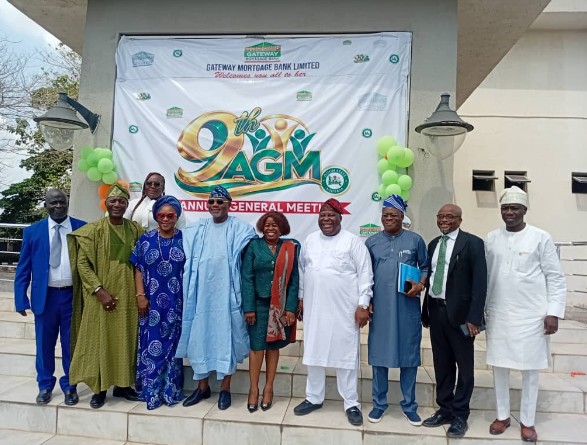
He spoke at the bank’s 9th Annual General Meeting (AGM), held in Abeokuta, Ogun State, where he identified mortgage institutions as critical drivers of efforts to bridge the country’s housing gap.
According to him, mortgage banks play a dual role in facilitating homeownership for individuals and providing property developers with the financing required to expand housing construction.
He stressed that strengthening mortgage financing would increase developers’ capacity to deliver more housing units while making homeownership accessible to more Nigerians.
The Gateway Mortgage Bank chairman added that expanding affordable housing supply would ease pressure on the property market and help moderate the persistent increase in rental costs across major urban centres.
He, however, identified access to long-term funding as one of the major challenges confronting mortgage institutions, explaining that the long repayment periods associated with housing loans made it difficult for banks to depend on short-term deposits.
“The minimum tenure for a mortgage is 10, 15 or 20 years. You cannot take people’s money when they expect it back in 90 days and put it into a property that will not pay back until 15 years,” he said.
He therefore called for sustainable funding arrangements that would align with the long-term nature of mortgage financing, noting that access to appropriate capital was essential to expanding homeownership.
Durojaye also urged Nigerians, particularly young professionals and salary earners, to embrace mortgage financing early in their careers rather than commit substantial portions of their income to recurring rent payments.
“Instead of paying ₦2m in rent every year, why don’t you buy a house and start paying ₦200,000 monthly from your salary?” he asked.
He explained that mortgage arrangements allowed prospective homeowners to spread the cost of acquiring properties over an agreed period while building long-term assets instead of continually spending on rent.
To improve public awareness and encourage participation in the mortgage market, he said the bank had intensified its financial literacy campaigns through radio programmes, engagements with market associations and interactions with civil society organisations.
He added that the institution was also prepared to leverage available Federal Government intervention funds to expand access to housing finance.
On the bank’s financial performance, Durojaye disclosed that Gateway Mortgage Bank recorded a 12 per cent increase in profit after tax, rising from N179.08 million in 2024 to N199.79 million in 2025, despite prevailing economic challenges.
He said the bank’s total assets also grew by 22 per cent, from N11.09 billion to N13.52 billion, while its loan portfolio expanded by 26 per cent to N5.77 billion.
He attributed the performance partly to the support of the Ogun State Government, its ministries and agencies, noting that the bank had continued to play an active role in the state’s housing development initiatives by providing mortgage facilities to beneficiaries of government housing schemes.
A breakdown of the audited financial statements for the year ended December 31, 2025, showed that profit before tax increased by approximately five per cent, from N271.25 million in 2024 to N284.34 million.
Interest income from loans rose by 28 per cent, from N756 million to N969.48 million, while investment income increased by 63 per cent, from N689.36 million to N1.13 billion.
The bank’s deposit liabilities also grew by 36 per cent, from N3.69 billion to N5.02 billion, indicating increased customer deposits during the period.
However, operating expenses rose by 32 per cent, from N1.12 billion to N1.48 billion. The bank also recorded an impairment allowance charge of N16.49 million, compared with an impairment reversal of N13.28 million in the preceding financial year.
Meanwhile, the Ogun State Commissioner for Finance, Otunba Dapo Okubadejo, who represented Governor Dapo Abiodun at the AGM, attributed the state’s growing investment profile to improvements in infrastructure, security and the business environment.
Okubadejo described investment as the fundamental driver of economic growth, explaining that industrial expansion generated employment, increased household incomes, strengthened government revenue and stimulated activities across different sectors.
“What increases Gross Domestic Product is fundamentally investment,” he said.
He noted that the establishment of manufacturing companies in Ogun State had strengthened local value chains by encouraging the sourcing and processing of raw materials within the state, thereby reducing transportation and production costs.
The commissioner said the state government’s development agenda, anchored on its ISEYA framework covering infrastructure, social welfare and well-being, education and human capital development, youth empowerment, and agriculture and food security, had continued to support economic expansion.
He explained that the administration’s industrialisation drive was underpinned by deliberate investments in road infrastructure, electricity, security and industrial clusters.
According to him, the Abiodun administration has constructed and rehabilitated more than 1,700 kilometres of roads across the state, with projects distributed among its major geographical divisions.
He said the improved road network had eased transportation and logistics challenges for manufacturers while making Ogun State increasingly attractive to local and foreign investors.
“Today, when you look at the industrial corridors, particularly along the Sagamu interchange to Abeokuta, you see the proliferation of factories and industries. There can only be one reason why investors are trooping into Ogun State,” he said.
Okubadejo identified security as another critical consideration for investors, saying the state government had continued to support security agencies with technology, logistics, infrastructure and financial assistance to tackle kidnapping and other security threats.
On electricity, he disclosed that more than 500 companies had been connected to independent power arrangements through partnerships with private-sector operators, providing businesses with relatively stable electricity outside the national grid.
He said the initiative had helped reduce production costs, particularly for manufacturers whose operations depended heavily on uninterrupted power supply.
The commissioner also highlighted the government’s industrial cluster initiative, designed to provide businesses with shared infrastructure and essential services, including electricity, water, security, fire management and waste disposal.
He identified the proposed and existing industrial development corridors as including the Ijebu industrial corridor, the Remo cluster around the Gateway International Airport and its proposed aerotropolis, the Abeokuta corridor and the Egba industrial cluster.
According to him, the shared-infrastructure model would enable businesses to operate more efficiently without individually bearing the enormous costs of providing essential facilities.
He further disclosed that Ogun State had recently recorded a major investment commitment with the groundbreaking of the Lead Group’s first industrial park, valued at $1.8 billion.
On the Gateway International Airport, Okubadejo said the state government conceived the project as an aerotropolis, an airport-centred urban development designed to stimulate commercial, industrial and other economic activities beyond conventional passenger and cargo operations.
He said the airport’s 4.1-kilometre runway was designed to accommodate large cargo aircraft while supporting passenger operations.
The commissioner added that the airport’s accessibility through major road networks, including the Lagos-Ibadan Expressway, Sagamu-Benin Expressway and Abeokuta-Ikenne corridor, gave it a strategic advantage.
He also disclosed that the state government had acquired two Bombardier CRJ900 aircraft, each with a seating capacity of 90 passengers, as part of efforts to strengthen the airport’s commercial operations.
According to him, one of the aircraft had been deployed for operations between Gateway International Airport and Abuja, while the other was being managed by ValueJet as part of its fleet.
On housing, Okubadejo said the state had delivered an estimated 6,000 to 7,000 housing units under the present administration.
He explained that the projects, spread across different parts of Ogun State, were designed to cater for different income groups, including low- and high-income earners, while encouraging more people to live and work in the state.
He also highlighted reforms in land administration, particularly the introduction of the Ogun State Land Administration and Revenue Management System (OLARMS), which he said had improved land documentation and the processing of Certificates of Occupancy through digital procedures.
Although the system experienced some challenges during its initial implementation, he expressed confidence that the difficulties were being progressively addressed.
On the broader national economy, Okubadejo said the state government was encouraged by improvements in key economic indicators, including foreign exchange stability, foreign reserves and investment activities.
He acknowledged, however, that economic reforms required time and continued sacrifices, maintaining that Ogun State remained committed to strengthening its position as a preferred investment destination and industrial hub.
The AGM provided shareholders with an opportunity to review the bank’s financial position, assess its performance during the 2025 financial year and consider strategies for expanding its operations in Nigeria’s mortgage banking industry.
In his closing remarks, Durojaye thanked shareholders, the Ogun State Government and other stakeholders for their continued confidence in the institution.
He assured them that the board remained committed to sustaining the bank’s growth trajectory, strengthening its operations and improving profitability while expanding access to mortgage financing.