By Kazeem Waris
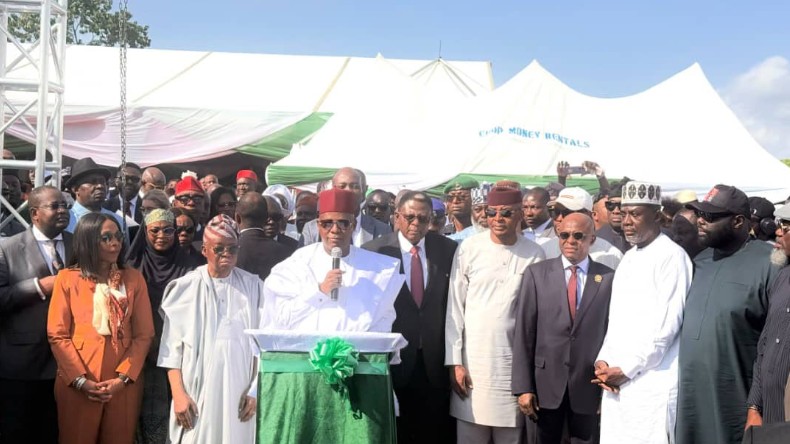
Vice-President Kashim Shettima on Friday performed the groundbreaking of the Bakassi Deep Seaport in Cross River State, declaring that the multibillion-dollar project would end the state’s economic isolation, unlock Nigeria’s blue economy and reduce the country’s overdependence on Lagos ports.
Shettima, who represented President Bola Tinubu at the ceremony in Calabar, described the project as a landmark economic intervention that would reposition Nigeria’s maritime sector, boost international trade and create thousands of jobs.
He said the seaport was beyond political considerations, describing its commencement as evidence of governance and political will.
“I have not come to Calabar to cut a ribbon and dance Ekpe Masquerade. I am here to break ground and break centuries-old jinx,” the Vice-President declared.
Shettima argued that Nigeria’s overdependence on Lagos for international trade had become an economic weakness, stressing the need to develop alternative maritime gateways to improve the country’s competitiveness.
“When over 80 per cent of our foreign trade flows through Lagos alone, that is not strength. That is congestion,” he said.
He added: “When Lagos is free, Nigeria breathes. And when Calabar walks, Nigeria walks on two legs.”
The Vice-President noted that Nigeria had 853 kilometres of coastline and controlled more than 60 per cent of West Africa’s Gross Domestic Product, GDP, yet accounted for only about 25 per cent of the region’s cargo trade.
According to him, the country’s inability to maximise its maritime advantage had allowed neighbouring countries to benefit from cargo and port-related businesses that should ordinarily be handled by Nigerian facilities.
“Truth is, our neighbours are eating the food from our own port,” he said.
Shettima described the ocean as a major economic asset capable of transforming national development, saying Nigeria’s blue economy could generate $44 billion, equivalent to about N70 trillion, annually.
He further disclosed that the Tinubu administration generated N1.83 trillion from the sector in 2025, representing a 160 per cent increase from N700 billion recorded in 2023.
“The sea is no longer just water to look at. It is wealth to harvest,” he said.
The Vice-President explained that the Bakassi Deep Seaport would stimulate economic activities across several sectors, including shipping, logistics, agriculture, manufacturing, tourism, fishing and hospitality.
e said the facility would provide an export gateway for agricultural produce and manufactured goods from Cross River and neighbouring states, while creating employment opportunities for professionals and artisans.
According to him, crane operators, truck drivers, welders, engineers, customs officers, hotel operators and market women would all benefit from the economic opportunities the port would generate.
“Cocoa from Ikom, rice from Ogoja, timber, solid minerals and manufactured goods from the industrial park will find a home in this port. Calabar will become again what it was, a city of merchants,” he said.
Addressing the historical loss of the Bakassi Peninsula, Shettima urged the people of the area not to regard the development as the end of their economic prospects, but as an opportunity for a new beginning.
“Bakassi was not the end of their story, but the beginning of their next chapter.
“The same water that took something from you will now bring something back,” he said.
He urged Cross River residents to protect the project from political interference and misinformation, while calling for sustained support for the administration’s development agenda.
In his remarks, Governor Bassey Otu thanked President Tinubu for approving additional marine corridors and supporting the actualisation of the deep seaport, which he said had suffered years of political, administrative, legal and environmental bottlenecks.
“Today, a milestone of inestimable significance has been achieved through the instrument of the Renewed Hope mantra of Mr President,” Otu said.
The governor disclosed that his administration had completed the environmental impact assessment, hydrographic, geotechnical and geophysical surveys required for the project.
He said the project had also secured Federal Executive Council technical approval, with an initial funding arrangement of $2.27 billion, to be executed through a public-private partnership.
Otu further revealed that the Federal Government retired the old 1903 British navigational charts on October 1, 2026, replacing them with updated charts that affirmed the state’s survey findings.
“With this development, the debate on our state’s littoral status has been put to an irrevocable end,” he declared.
The governor said some Cross-River indigenes were already undergoing specialised training to equip them for the construction and operational phases of the project.
“The Bakassi Deep Seaport is going to be a definitive economic game-changer,” he said.
He explained that the project would attract investments into logistics, international trade, fishing, shipping, tourism and shipbuilding, while strengthening the state’s position as a major commercial destination.
Otu said the combination of the proposed seaport, the airport and the Lagos-Calabar Coastal Highway would give Cross River a strategic advantage in regional and international commerce.
He described the state as “a business haven for any astute investor”, assuring prospective investors of one-stop investment hubs and tax incentives.
The governor, however, lamented Nigeria’s poor capture of cargo traffic meant for the country, estimating that only between 20 and 25 per cent of such cargo was handled domestically.
He observed that Apapa remained the country’s biggest port in 2026, just as it was in 1960, describing the situation as evidence of decades of inadequate investment in port infrastructure.
“That shows you, in terms of under-investment, how we have lagged behind,” he said.
Earlier, the Africa Finance Corporation (AFC) pledged to support the development of an economic corridor around the Bakassi Deep Seaport, insisting that the project must generate industrial growth and employment beyond the port facilities.
Speaking at the groundbreaking ceremony, the corporation’s representative, Mrs Kanayo Awani, said the deep-water facility would enable larger vessels to berth, reduce cargo transportation costs and improve market access for farmers and manufacturers.
She stressed that the success of the project would depend on complementary investments in transport infrastructure, agro-processing facilities, reliable electricity, water supply, digital connectivity and skills development.
Awani warned against developing a port that would merely facilitate the importation of finished goods without building local industries capable of adding value to Nigeria’s agricultural and industrial output.
“A port that only lands these imports keeps us dependent,” she said.
“A corridor with industry along it lets the cocoa, cassava and other produce of this region leave as finished goods.”
She pledged the AFC’s readiness to work with the Federal and Cross River State governments to develop the economic corridor and ensure the project delivers broader economic benefits.
“AFC is ready to help bring this vision to pass,” she said.
The Bakassi Deep Seaport is expected to serve as a major maritime gateway for Cross River and the wider South-East and North-Central regions, while providing an alternative route for international trade and strengthening Nigeria’s position in the Gulf of Guinea.