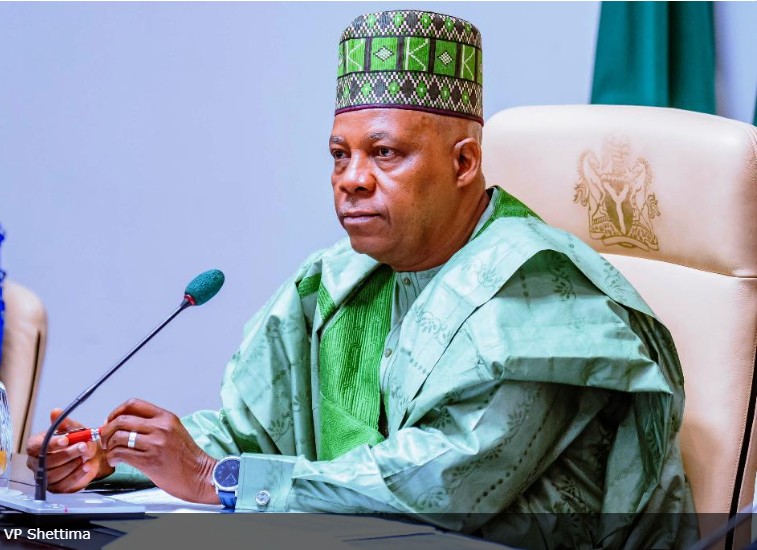
By Kazeem Waris
Vice President Kashim Shettima has defended President Bola Tinubu’s economic reforms, saying Nigeria was “teetering on the verge of collapse” when the administration took office and crediting the President with saving the economy from falling apart.
Shettima said the decision to remove the petrol subsidy and unify the multiple exchange rates, though difficult, was necessary to prevent a deeper economic crisis.
The Vice President spoke after meeting with Tinubu at the President’s Lagos residence, where he said the administration had remained in regular contact with the President during his recent time abroad.
“We are quite thrilled that he is back on the beat, and we have been in regular contact throughout his sojourn abroad,” Shettima said.
“Advances in science and technology have made it possible to really have impactful leadership wherever one might find himself. So, we have been in regular contact. We speak almost every other day, and we are updating him.”
He saved the economy
Shettima said Tinubu inherited an economy facing severe pressure, citing foreign reserves of $3.9 billion at the time the administration assumed office.
“When we assumed the mantle of leadership, our foreign reserves were a staggeringly low 3.9 billion dollars — that was not enough to import oil for one month. He had the courage and the conviction to take far-reaching decisions,” he said.
“The withdrawal of the fuel subsidy, the realignment of the multiple exchange rates, were far-reaching decisions.”
According to the Vice President, the measures were required to prevent the country from sliding into a more severe economic crisis.
“The economy was actually teetering on the verge of collapse. He saved the economy. I want Nigerians to understand this fundamental truism.
“We are on the road to Caracas. He saved our economy. He saved the nation from falling to pieces,” Shettima said.
He acknowledged the hardship caused by the economic reforms but urged Nigerians to remain patient, saying the government was working on measures to cushion their effects.
“We appreciate the pains Nigerians are going through, but tough times do not last forever. Tough people do,” he said.
Northeast gets new interventions
Shettima announced plans for interventions in the North-East, including e-logistics, electric tricycles, buses and taxis, aimed at reducing transportation costs and easing economic pressure on residents.
“In the next couple of weeks, we are going to launch e-logistics in the northeast, we are going to run 10,600 electric tricycles to ease the pains of the people in the northeast, and 300 buses and taxis, e-taxis.
“All these were meant to ameliorate the sufferings of our people,” he said.
The Vice President also described the Nigerian Education Loan Fund, NELFUND, as a major intervention for students from low-income families.
“The president has empathy, a lot of empathy for the common man. The NELFUND is a masterstroke aimed at assisting students of limited means to have access to drink from the Western Spring,” Shettima said.
He assured Nigerians that the administration would continue to introduce programmes aimed at easing economic hardship.
On the 2027 political season, Shettima acknowledged the growing political activities but said governance would remain a priority.
“Politics is in the air, but we will combine politics and governance,” he said.