By Destiny Obinna
Farmers in Nasarawa State have commended the Sasakawa Africa Association (SAA) for equipping them with climate-smart and nutrition-sensitive farming techniques, saying the intervention has improved crop yields, product quality and market value.
The farmers said the training had also enabled them to share the knowledge acquired with other farmers in their communities and beyond.
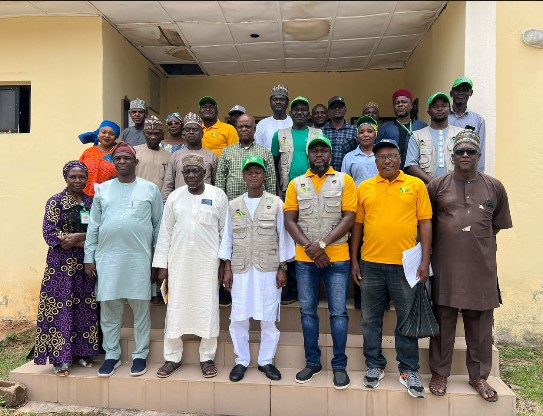
They spoke with journalists recently during a two-day media field tour of SAA projects in Lafia, Obi and Doma Local Government Areas of the state, organised to provide direct access to beneficiary farmers, demonstration farms, technologies and project outcomes.
At Tudum Adobu and Agwan Hamidu communities in Obi Local Government Area, where soybean-maize demonstration, intercropping and provitamin A plots were established, farmers expressed satisfaction with the results, describing the demonstration farms as more organised and productive than their traditional farming methods.
The Chairman of Ayinewoza Farmers Cooperative, Bashir Ogbole, said the improved seeds had performed better despite harsh weather conditions associated with climate change.
He said the training enabled farmers to adopt modern techniques that improved yields, nutritional content and the market value of their produce.
“Seriously, we have a far, far difference. Because we have not harvested the farm yet, but it shows us that it has a far difference compared to our own. You can see the way they taught us. We plant this seed at 75 centimetres. But in our traditional method, there was no issue of distance; we just planted it,” he said.
Ogbole urged the government to adopt and expand the Sasakawa farming model across the state as a means of improving food production and making agriculture more attractive to farmers.
Another farmer, Jibril Elayo, said the introduction of one-seed-per-hole planting and proper spacing had improved their understanding of modern crop production.
“Before now, you hardly find a farmer planting maize one seed per hole. It’s not a common practice. Probably they feel these seeds will not germinate, but now we have been introduced to a technology of one seed per hole and at a spacing of 25 centimetres between stands,” he said.
Elayo also said the four-by-four rotation system between maize and soybean was helping to retain soil moisture and improve phosphorus uptake.
At Madagba Watta community in Doma Local Government Area, a women farmer group leader, Mrs Felicia Alaku, said the production of orange-fleshed sweet potatoes had provided them with an additional source of nutritious food, particularly because of its Vitamin A content.
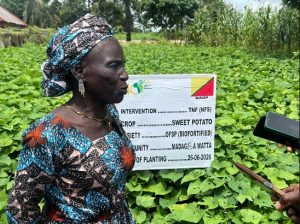
Alaku said the farmers had also been trained on different ways of processing the crop, including making porridge, juice and snacks.
“They showed us how to prepare it, demonstrating everything practically. They showed us how to make porridge out of it, and when we tasted it, it was delicious. They showed us how to make juice from it, and when we drank it, it was great,” she said.
She added that the women were also taught how to boil and store the crop and manage their farms.
The farmers said the early maturity of the improved crops was another advantage, as it enabled them to adapt to changing rainfall patterns and, in some cases, cultivate the same portion of land twice within a year.
Receiving the Sasakawa team in her office, the Permanent Secretary in the Nasarawa State Ministry of Agriculture and Food Security, Hajiya Salamatu Oseze, commended SAA for its intervention.
She said the partnership between the Sasakawa Africa Association and the Nasarawa Agricultural Development Programme (NADP), an agency of the ministry, had generated positive testimonies from farmers.
Oseze urged the programme manager to consider expanding the Sasakawa projects to more rural communities across the state.
At the College of Agricultural Science and Technology, where SAA established a family business garden, the programme coordinator, Dr William Akaamar, said the initiative was helping to address food insecurity by encouraging families to cultivate vegetables on small portions of land.
Akaamar said the garden had also become a source of vegetables for neighbouring communities while generating income for beneficiaries.
He explained that students were being trained in nutrition-sensitive agriculture, including the production of vegetables suitable for different age groups and nutritional needs.
According to him, food security involves ensuring that nutritious food is available, accessible and affordable.
Speaking earlier, the Country Director of Sasakawa Africa, Dr Godwin Atser, represented by the Technical Coordinator for Climate Resilience and Agrifood Systems, Nathaniel Otene, said the organisation was encouraged by the improvement in farmers’ productivity.
He said the programme linked increased productivity directly to higher incomes and improved livelihoods for smallholder farmers.
“We are living in a time and age where climate change is affecting the entire agricultural production system, and there’s that need to come up with varieties that can withstand some of these extreme weather conditions that smallholder farmers are facing,” he said.
Otene also clarified that the agricultural methods being promoted by SAA were different from genetically modified organisms (GMOs), explaining that the approach involved combining desirable traits to develop crops suited to farmers’ needs and changing climatic conditions.