By Lillian Nwafor
Experts have called for greater accountability in the implementation of Nigeria’s National Policy on Food and Nutrition, warning that inadequate gender-responsive budgeting and weak implementation structures could undermine its objectives.
They said that although government policies increasingly recognise the importance of gender and nutrition in agricultural development, the absence of deliberate budgetary allocations and effective monitoring mechanisms remained a major challenge.
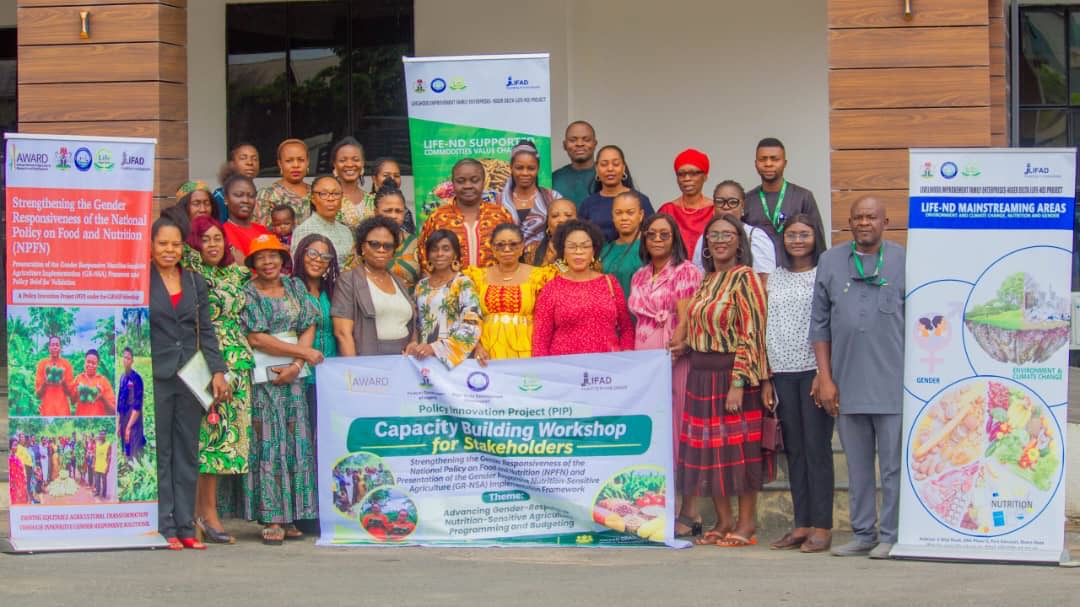
The experts spoke at a stakeholders’ workshop in Umuahia, Abia State, organised by the African Women in Agricultural Research and Development (AWARD), in partnership with the International Fund for Agricultural Development (IFAD)-funded Livelihood Improvement Family Enterprises in the Niger Delta (LIFE-ND).
The workshop, with the theme, “Strengthening the Gender Responsiveness of the National Policy on Food and Nutrition,” sought to develop an implementation framework that would make agricultural programmes more gender-responsive and nutrition-sensitive.
National Nutrition Mainstreaming Specialist for LIFE-ND and AWARD GRASP Fellow, Mrs Chioma Obasi, said gender-responsive budgeting and effective implementation were among the critical gaps requiring attention in Nigeria’s food and nutrition policy.
Obasi explained that her fellowship assignment involved identifying gender gaps in the national policy and developing practical approaches to address them.
She disclosed that she was among 50 women selected across Africa for AWARD’s Gender Responsive Agricultural Systems Policy Fellowship.
According to her, the workshop was designed to enable stakeholders to examine and validate an already-developed framework for strengthening gender responsiveness in agricultural policies and programmes.
She said the broader objective was to equip stakeholders with the knowledge and strategies needed to ensure that government agricultural interventions reflected gender considerations.
Obasi observed that with ministries increasingly mainstreaming nutrition into their programmes, the involvement of relevant ministries and agencies was necessary to develop an effective implementation framework.
Workshop facilitator and Director of Research at the National Root Crops Research Institute, Umudike, Dr Okoye Benjamin Chukwuemeka, said the policy gaps identified by stakeholders required practical recommendations and urgent action.
He acknowledged government efforts to incorporate gender and nutrition into national policies but stressed that policy provisions must translate into tangible outcomes.
Chukwuemeka said Nigeria must look beyond food availability and pay greater attention to the nutritional quality of food consumed by households.
“It is no more only about food security but now about nutrition and food security. Sometimes you may have the food but no food security, so we match it up together,” he said.
He also called for stronger support for smallholder farmers, describing small-scale agriculture as an important contributor to food sustainability.
The facilitator said the workshop provided a platform for citizens and relevant stakeholders to identify obstacles to implementation and propose solutions.
He raised concern that many public officials were unfamiliar with the National Policy on Food and Nutrition, calling for its wider circulation across ministries, departments and agencies.
He said such awareness would help ensure that chief executives understood their responsibilities and could be held accountable for failures in implementing the policy.
In her virtual contribution, Co-Founder of LANOF National Council, Dr Nkiruka Stella Okonkwo, who is involved in the National Gender Policy on Agrifood Systems Transformation for Nigeria and its Strategic Plan of Action (2025–2030), urged stakeholders to remain committed to identifying policy gaps.
She said addressing the grey areas was necessary to strengthen policy development and implementation.
Meanwhile, Deputy Director of Nutrition in the Abia State Ministry of Budget and Economic Planning, Damian Oluchukwu, said the engagement had highlighted the need to reform the state’s budgeting approach.
She admitted that the existing budgeting process was not sufficiently gender-responsive, adding that the lessons from the workshop would inform future budget preparation and implementation.
“The major thing I learnt is that currently, our budgeting is not gender-responsive, and going forward, we need to adopt gender-responsive budgeting in the system,” she said.
Abia State Nutrition Officer of the Primary Healthcare Development Agency, Umerechi Ofoegbull, also called for a broader approach to nutrition interventions, saying they should not focus exclusively on women.
She said the workshop had expanded her understanding of nutrition mainstreaming by underscoring the need to involve other gender groups in nutrition-related programmes.