By Destiny Obinna
The Federal Government, Society for Family Health, SFH, Lagos State Government, Gates Foundation and Pharmacy Council of Nigeria, PCN, have begun moves to institutionalise the gains of the nine-year IntegratE Project, which enabled 1.7 million women to access family planning services across 11 states.
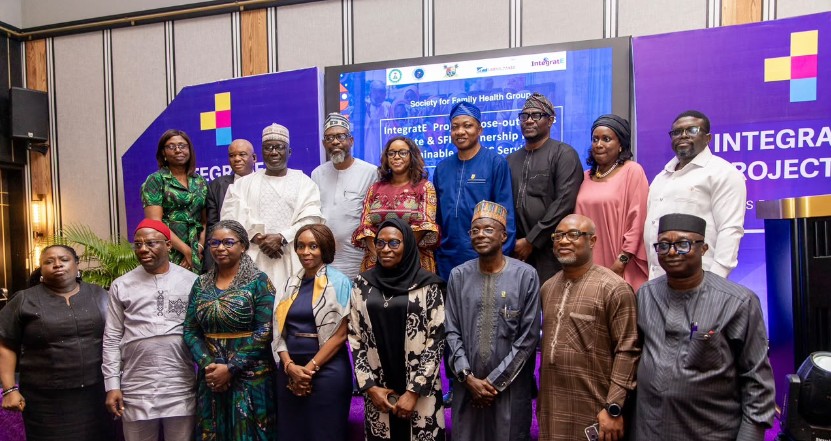
The stakeholders, at the close-out and dissemination meeting of the project in Lagos, said sustaining the gains would require stronger government ownership, continued training, effective referral systems, quality assurance and integration of private-sector health data into government systems.
Funded by the Gates Foundation and led by SFH, IntegratE began in 2017 with a pilot in Lagos and Kaduna, using a three-tier accreditation system to expand family planning services through Community Pharmacists, CPs, and Patent and Proprietary Medicine Vendors, PPMVs.
The project later expanded to nine additional states — Enugu, Gombe, Kano, Niger, Nasarawa, Borno, Yobe, Bauchi and Sokoto.
Between 2017 and 2026, 863 community pharmacists and 4,961 PPMVs were trained across the 11 states. The providers served 1,756,170 women, including 399,766 new family planning acceptors, while an estimated 117,775 unintended pregnancies were averted.
Speaking at the dissemination meeting, Director and Head of Reproductive Health Division, Federal Ministry of Health and Social Welfare, Dr Samuel Oyeniyi, said the end of the project should mark the beginning of efforts to sustain its achievements.
Oyeniyi said IntegratE had demonstrated that community pharmacies and PPMVs could be effectively integrated into the delivery of quality family planning and primary healthcare services.
He said more than 1.7 million women accessed family planning services through trained providers, while over 1.18 million children under five also received care.
He stressed the importance of continued public-private collaboration to improve health outcomes.
Speaking for the Gates Foundation, Director of Family Health in Nigeria, Rodio Diallo, said a major lesson from the project was that many women, particularly those in lower-income communities, sought healthcare from providers close to where they lived.
“The key learning is that if you give knowledge to healthcare workers and empower them, they will be better equipped to meet women’s reproductive health needs,” Diallo said.
She said assessments comparing trained CPs and PPMVs with providers at primary healthcare facilities showed comparable quality of care, providing evidence that supported the inclusion of community-based providers in Nigeria’s task-shifting and task-sharing framework.
Diallo said sustainability had been built into the project from the outset, with CPs and PPMVs now embedded in national policy.
“There is no going back,” she said.
However, she noted that with more than 200,000 PPMVs and community pharmacists estimated to be operating nationwide, the Gates Foundation could not train the entire workforce.
She called on government to budget for scaling up training and urged other development partners to invest in empowering community-level providers.
Representing SFH Group Managing Director, Dr Omokhudu Idogho, Group Director, SFH Donor Funded Portfolio, Pharm. Emeka Okafor, said the project’s sustainability strategy included building training capacity within existing institutions.
He said the project partnered with the Pharmacy Council of Nigeria to accredit Schools of Health Technology, which subsequently cascaded training to PPMVs.

Okafor said the approach would ensure that training capacity remained embedded in existing institutions after the project ended.
“These are not just statistics,” he said of the women reached and pregnancies averted, adding that they represented women, couples and families who “were able to make informed decisions about whether and when to have children.”
He said SFH would continue to provide technical assistance to state governments seeking to scale up the model.
The Registrar, Pharmacy Council of Nigeria, Pharm. Ibrahim Babashehu Ahmed, said IntegratE had strengthened the Council’s regulatory capacity by helping to map and categorise PPMVs according to their capacity.
“The essence of regulation is not to just put individuals or facilities in a straitjacket,” Ahmed said, noting that regulation should enable providers to meet the healthcare needs of their communities.
He said the proximity of PPMVs and community pharmacies to Nigerians, particularly those living far from public health facilities, made them important to efforts to achieve universal health coverage.
In Lagos, Director of Epidemiology, Biosecurity and Global Health at the state Ministry of Health, Dr Ismail Abdus-Salam, said IntegratE had provided “additional points of access” and “more opportunities for women and families to make informed reproductive health choices.”
Representing the Permanent Secretary, Dr Dayo Lajide, he said the close-out of the project raised an important question.
“As the project closes, the real question is: what happens next?” he asked.
He urged stakeholders to institutionalise approaches that had demonstrated value and strengthen private-sector engagement in the state’s reproductive health strategy.
Special Adviser to the Lagos State Governor on Health, Dr Kemi Ogunyemi, said sustaining the gains would require successful interventions to be integrated into existing state systems.
She identified continuous capacity strengthening, functional referral mechanisms, stronger integration and quality assurance of private-sector data, commodity security and regulatory compliance as critical to sustainability.
“Behind every number in a report is a person,” Ogunyemi said. “Behind every referral is a client waiting for care.”
Permanent Secretary, Lagos State Primary Healthcare Board, said the partnership had trained more than 904 providers and reached over 371,000 people in Lagos.
“Through your support, supervision became partnership, data became visibility, and providers became champions of client-centred care,” the Permanent Secretary said.
The Lagos results showed that 217,599 women accessed family planning services through trained providers, while an estimated 15,604 unintended pregnancies were averted. The providers also made 7,523 referrals to public health facilities.
Beyond family planning, trained providers attended to more than 146,341 children under five, tested 81,075 people for malaria and treated 42,790 confirmed cases, while also managing thousands of cases of diarrhoea and pneumonia.
Stakeholders identified government ownership, local training capacity, policy and regulatory institutionalisation, and stronger health information systems as key pillars for the next phase.
They also called for stronger referral pathways and integration of private-sector service data into government health information systems to ensure that the gains recorded under IntegratE translate into lasting improvements in access to family planning and primary healthcare services.