By Kazeem Waris
Infrastructure projects in Nigeria’s Niger Delta are significantly more expensive than those in the northern parts of the country because of the region’s difficult terrain and environmental conditions, the Minister of Regional Development, Engr. Abubakar Momoh, has said.
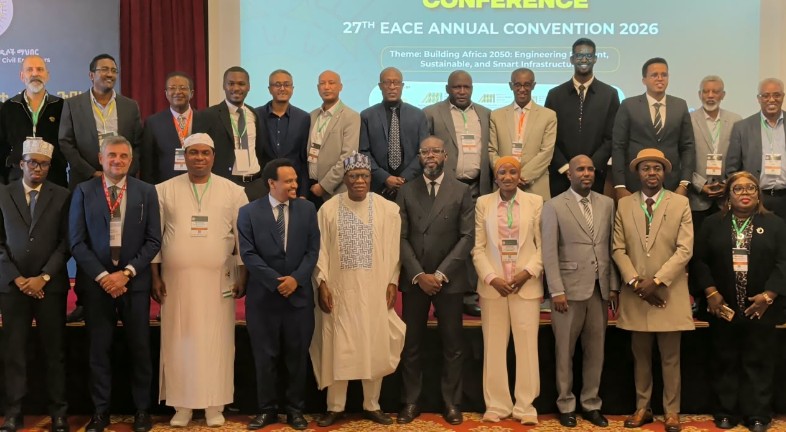
Momoh, who spoke in Addis Ababa, Ethiopia, at the 27th Convention of the Ethiopian Association of Civil Engineers, said the peculiar geography of the Niger Delta required specialised engineering solutions, often driving up project costs.
The convention was themed: “Building Africa 2050: Engineering Resilient, Sustainable, and Smart Infrastructure.”
According to the minister, infrastructure development in Nigeria cuts across diverse terrains, from coastal wetlands and river basins to erosion-prone communities, arid zones and rapidly expanding urban centres.
He said engineering designs suitable for one part of the country could be inadequate in another, particularly in the Niger Delta.
“The engineering solution suitable for the dry northern corridor may be wholly inadequate in the saturated soils and tidal environment of the Niger Delta,” he said.
Momoh explained that roads and bridges in the region often have to cross creeks, swamps and unstable soils, while construction materials and heavy equipment may have to be moved through narrow waterways.
“A project that appears straightforward on paper can become considerably more expensive once geotechnical conditions, community access and environmental safeguards are fully understood,” he said.
He, however, stressed that despite the challenges and costs, such projects remained critical to connecting isolated communities to schools, healthcare, markets and investment.
“This is where engineering concept and design matters a lot in preparing projects for execution,” the minister said.
Climate change raising infrastructure risks
Momoh said climate change had also altered the assumptions on which much of Nigeria’s infrastructure was originally designed, citing the severe floods of 2012 and 2022.
According to him, the floods damaged power installations, roads and bridges, disrupted transportation and livelihoods, and exposed weaknesses in drainage, floodplain management and emergency access.
He said rising water levels, shoreline erosion and saline intrusion were threatening settlements and transport infrastructure in coastal communities, while higher temperatures, drought and desertification were placing additional pressure on water, agriculture and energy systems in northern Nigeria.
The minister also identified fragmented planning, land acquisition disputes, utility relocation, lengthy procurement processes and weak coordination among different levels of government as factors delaying infrastructure projects.
He said inflation and foreign exchange pressures had further increased the cost of imported machinery and specialist inputs, while insecurity in some areas disrupted construction and raised project costs.
“Too often, limited maintenance converts a manageable defect into expensive reconstruction,” Momoh said.
‘Smart infrastructure goes beyond sensors’
On urban development, the minister said rapid urbanisation was putting increasing pressure on public infrastructure, with roads sometimes becoming drainage channels during intense rainfall and buildings springing up on natural waterways.
He warned that smart infrastructure could not be achieved simply by installing sensors on poorly planned systems.
“It begins with integrated land-use planning, reliable data, enforceable standards and clear institutional responsibility,” he said.
Momoh said the Federal Government, under President Bola Tinubu’s Renewed Hope Agenda, was treating infrastructure, energy security, economic reform and sustainable development as interconnected priorities.
He cited the Climate Change Act 2021 and the Energy Transition Plan as key frameworks for low-carbon and climate-resilient development, with the latter providing a pathway towards net-zero emissions by 2060.
CNG, EVs need complete infrastructure

The minister also highlighted the government’s transport-energy transition, saying the Presidential Initiative on Compressed Natural Gas was accelerating the deployment of CNG conversion centres, vehicles, equipment and refuelling infrastructure across the country.
He said the initiative’s mandate was expanded in March 2026 to include electric vehicles, charging infrastructure and related investments.
“This will tremendously reduce exposure to petrol-price volatility, make public transport more affordable, stimulate local vehicle assembly and component manufacturing, and create new technical jobs,” he said.
Momoh stressed, however, that CNG and electric mobility required complete engineering systems rather than isolated vehicles.
He said CNG deployment depended on safety standards, reliable gas distribution, certified conversion, trained technicians and strategically located refuelling facilities, while electric mobility required reliable power, interoperable charging systems, battery standards, recycling systems and proper urban transport planning.
Lagos-Calabar highway
The minister also cited the 700-kilometre Lagos-Calabar Coastal Highway as an example of the scale and complexity of Nigeria’s infrastructure ambitions.
According to him, the project must respond to difficult coastal conditions, protect communities and ecosystems, manage flood risks and secure long-term financing.
He said public-private partnerships and innovative financing would be essential because public budgets alone could not meet Nigeria’s infrastructure needs.
“Private finance will only enter at scale where projects are properly prepared, risks are allocated fairly, procurement is credible, tariffs or revenue models are realistic, and contracts are honoured,” Momoh said.
He cited the Keffi-Makurdi Road, part of the Abuja-Keffi-Lafia-Makurdi Highway, as an example of a public-private partnership road project under the Federal Government’s Highway Development and Management Initiative.
Infrastructure must be built for future climate
Momoh urged African countries to design infrastructure for future climate conditions rather than relying solely on historical weather patterns.
“Resilience must be built into feasibility studies, procurement documents and asset-management plans, rather than added after disaster strikes,” he said.
He also called for maintenance to be treated as an integral part of infrastructure development, saying major assets should have funded maintenance plans, clear ownership, condition monitoring and performance indicators.
The minister urged African countries to deploy digital technologies, including building information modelling, geographic information systems, remote sensing, drones, digital twins, smart meters and predictive maintenance.
He noted, however, that such technologies must be backed by skilled personnel, cybersecurity, data governance and institutions capable of acting on the information generated.
Momoh further called for stronger African value chains in construction materials, cables, meters, charging equipment, public transport vehicles and renewable-energy components.
“Our continent should not remain merely a market for imported engineering systems,” he said.
He also advocated stronger cross-border infrastructure, including connected power pools, transport corridors, fibre networks, logistics systems and water-management arrangements.
According to him, the African Continental Free Trade Area cannot achieve its full potential if goods remain trapped behind weak ports, damaged corridors and incompatible standards.
Momoh urged professional engineering bodies to uphold standards, ethics and competence, promote continuous professional development, mentor younger engineers and communicate risks clearly to policymakers and the public.
He said Nigeria was ready to deepen cooperation with Ethiopia and other African countries in transport corridors, hydropower, renewable energy, urban development, regional institutions, geotechnical engineering, digital project management and professional accreditation.
He said the real measure of African infrastructure by 2050 should not be the number of kilometres announced or the size of contracts awarded, but whether infrastructure continues to function under changing environmental conditions and expands economic opportunities.
“It will be whether a farmer can reach a market after heavy rain; whether a coastal road remains safe as the climate changes; whether a growing city can move people efficiently; whether reliable power reaches homes and factories; and whether every project expands opportunity without imposing an unsustainable burden on the next generation,” he said.