By Destiny Obinna
Nigeria risks losing the economic and healthcare benefits of biomedical research unless universities, government and industry invest in research infrastructure and build effective systems for translating scientific discoveries into marketable products, patents and treatments.
The Vice-Chancellor of the University of Lagos (UNILAG), Prof. Folasade Ogunsola, gave the warning while calling for a fundamental shift in the country’s approach to biomedical research, insisting that scientific discoveries must move beyond academic publications to generate innovations, create businesses, attract investment and improve healthcare delivery.
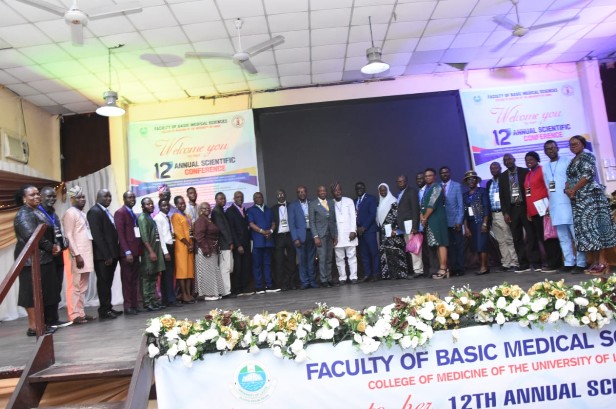
Ogunsola spoke at the 12th Annual Scientific Conference of the Faculty of Basic Medical Sciences, College of Medicine, UNILAG, held at the Old Great Hall, Idi-Araba, Lagos, on November 11, 2026.
The conference, themed, “Strengthening Biomedical Sciences for Innovation and Effective Research Outcomes: Strategies for Improved Healthcare,” brought together academics, industry professionals and international experts to examine how research could drive healthcare improvements and national economic development.
The vice-chancellor said Nigeria had significant opportunities to turn biomedical research into an economic asset through intellectual property, patents, royalties and locally developed products.
“The patents and royalties and IPs from new products can make research huge and make it an economic development tool,” she said.
She explained that investment in research could generate employment, stimulate entrepreneurship, strengthen local industries and contribute to a healthier and more productive population.
Ogunsola also raised concerns about Africa’s limited representation in clinical trials, warning that medical products developed without adequate participation of African populations might not always produce the expected outcomes when used locally.
She said Africa accounted for about 24 per cent of the global disease burden but remained underrepresented in clinical research.
“We are not Caucasians. And most clinical trials have been done on Caucasians. The way diabetes affects us, the way high blood pressure affects us, the way cardiovascular disease affects us, is different from the way it affects Caucasians or from the way it affects people in high-income countries,” she said.
According to her, research must reflect the genetic, environmental and health characteristics of the populations expected to benefit from new treatments.
“Sometimes you wonder why you’re using something for cancer in these patients and it’s not working. It’s not working because it wasn’t tested in people like him or her,” she added.

Also speaking, the Managing Director and Chief Executive Officer of the Nigerian Railway Corporation, Dr Isiak Kayode Opeifa, challenged young scientists to develop practical laboratory competencies and ensure their academic knowledge could be applied to real-world challenges.
Opeifa, an alumnus of the College of Medicine, UNILAG, drew from his experience in the United States and the biotechnology and pharmaceutical industries to emphasise the importance of practical training, advanced laboratory equipment and exposure to industrial research.
He recalled that access to specialised laboratory equipment, particularly high-performance liquid chromatography, contributed significantly to his professional development.
He urged students not to allow limitations in their local training environments to discourage them from acquiring additional knowledge and practical experience.
According to him, young scientists must take advantage of digital learning platforms, multidisciplinary collaboration and emerging technologies, including artificial intelligence, to improve their research capabilities.
Opeifa stressed that scientific discoveries would have limited economic impact if they remained confined to laboratories and academic publications.
“We have to move from the lab to the market,” he said.
He maintained that research must be developed into products that address identifiable needs and attract industry investment, adding that practical skills and the ability to solve problems remained essential to international competitiveness.
In his contribution, Dr Kwaku Baryeh, Director of Clinical Chemistry at Eli Lilly and Company, Indiana, United States, said Africa possessed the scientific talent to contribute meaningfully to global medical innovation but lacked sufficiently developed systems to translate research questions into treatments and commercial products.
He identified inadequate research infrastructure, funding gaps, limited workforce development and weak collaboration between universities and industry as major obstacles.
“The problem that we have here is not a lack of talent, but a lack of asking the right questions and having a system that translates those questions into treatment, into products that will reach patients in Accra, that will reach patients in Lagos, that will reach patients around the world,” Baryeh said.
He argued that research priorities should be driven by Africa’s disease burden and the healthcare needs of its populations rather than relying exclusively on research agendas developed elsewhere.
Baryeh also stressed the importance of reliable laboratory equipment, proper maintenance, quality management systems, data integrity and internationally acceptable research standards in building confidence in scientific findings.
He called for stronger partnerships between universities and industry, improved technology-transfer mechanisms and institutional structures that would enable researchers to protect and commercialise their intellectual property.
On funding, he advocated diversified sources of research financing, including government, private-sector investment, philanthropy and university alumni contributions, rather than dependence on a single funding source.
He further urged Nigerian universities to strengthen partnerships with scientists in the diaspora, whose expertise could support local research through mentorship, knowledge exchange and institutional collaboration.
The discussions highlighted the need for Nigeria to move beyond producing scientific knowledge to building a functional research and innovation ecosystem capable of converting discoveries into practical solutions.
For the country, the experts suggested, investment in biomedical sciences should not be viewed merely as an academic responsibility but as a strategic economic and healthcare priority capable of stimulating local industries, creating employment, reducing dependence on imported medical innovations and improving patient outcomes.