By Desire Uzochukwu
Lagos State Government has intensified efforts to make voluntary blood donation a regular habit among residents, warning that timely access to safe blood can mean the difference between life and death in medical emergencies.
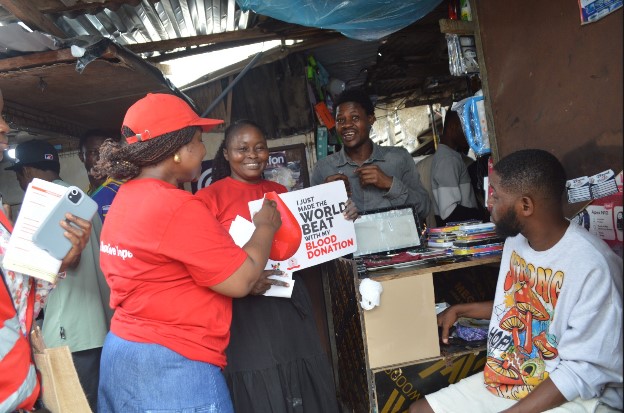
The campaign, led by the Lagos State Blood Transfusion Service, LSBTS, began in Eti-Osa Local Government Area with an advocacy walk and one-on-one sensitisation at Jubilee Bridge and Jubilee Market, Ajah.
The Executive Secretary of LSBTS, Dr Bodunrin Osikomaiya, said the initiative was designed to move blood donation beyond emergency responses and encourage eligible residents to become regular voluntary donors.
Osikomaiya said the Eti-Osa exercise was the first of 10 advocacy and sensitisation programmes planned across the state’s 20 local government areas.
She said: “The objective is to ensure that safe blood is readily available for residents whenever it is needed. We want voluntary blood donation to become a lifestyle and not something people only think about when a relative or friend needs blood.”
According to her, residents had the opportunity to donate through the blood mobile stationed at the venue or at designated government hospitals.
She said the campaign would be extended to Ojo, Ibeju-Lekki, Badagry, Epe and Lagos Island, among other areas, adding that the state government had provided the funding, personnel and logistics needed to strengthen blood collection and supply.
At the Maternal and Child Centre, MCC, Eti-Osa, Osikomaiya presented blood bags, gloves, sample bottles, donor forms, information materials and voluntary blood donation cards to support the facility’s blood collection activities.
She explained that residents issued voluntary blood donation cards would be entitled to receive blood without out-of-pocket payment when the need arose.
The Medical Director of MCC Eti-Osa, Dr Olufemi Aletan, said the partnership with LSBTS had highlighted the importance of maintaining adequate blood stocks, particularly for pregnant women and patients experiencing severe bleeding.
Aletan recalled instances where the facility needed fresh frozen plasma for patients, stressing that delays in accessing blood products could have serious consequences.
He said the hospital was working towards establishing an independent blood bank and urged residents, especially husbands of pregnant women, to donate regularly.
“Timely access to blood can determine whether a patient survives or not. We therefore need more people to come forward and donate blood regularly,” Aletan said.
For some residents, personal experiences have reinforced the importance of voluntary donation.
A 13-time blood donor, Mr Olawale Alaba, said donating blood was a simple act that should not be restricted to situations where family members or friends were in need.
“Blood donation is simple. You do not have to wait until somebody close to you needs blood before you donate. If you are eligible, donate regularly because someone somewhere may need it urgently,” he said.
Alaba encouraged eligible residents to donate every three months, describing regular donation as a practical way of saving lives.
Another donor, Mr Taiwo Abifarin, who has donated twice, said he was motivated by the desire to save lives and contribute to society.
“It is a way of saving lives and giving back to society,” he said.
First-time donors, including Messrs Abdullahi Mohammed, Rabiu Abiodun and Gbadamosi Sulaiman, also called on residents to overcome fear and embrace voluntary blood donation.
Sulaiman said his decision was influenced by a previous experience in which his child needed blood, describing donation as a responsibility that should be taken seriously by citizens.
The campaign is expected to continue across selected local government areas as the state seeks to broaden the pool of voluntary donors and improve the availability of safe blood for patients requiring transfusion.