By Kazeem Waris
The Nigeria Immigration Service (NIS) has pledged to address operational gaps and challenges identified in its Visa and Residency Reforms following a one-year assessment of the programme, as the Nigerian Army promised stronger collaboration with the Service to secure the country’s porous borders.
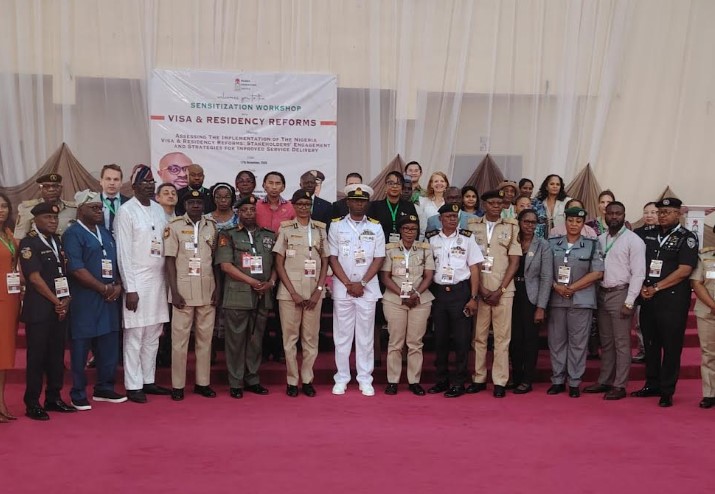
The Comptroller-General of Immigration, Kemi Nandap, gave the assurance in Abuja on Tuesday while declaring open a one-day stakeholders’ sensitisation workshop on the reforms, which were introduced to modernise immigration processes, improve service delivery and strengthen national security.
Nandap, who was represented by the Deputy Comptroller-General in charge of Visa and Residency, Dr Franca Usiwoma Nwanneka, said the assessment would provide an opportunity to examine the progress made, identify shortcomings and develop strategies to improve the system.
“As we assess the implementation of the reforms over the last one year, we have reasons to appreciate the progress made so far. However, we must also be ready to identify the areas where we have not done well and take the necessary steps to address them,” she said.
The workshop, themed, “Assessing the Implementation of the Nigeria Visa and Residency Reforms: Stakeholders’ Engagement and Strategies for Improved Service Delivery,” brought together stakeholders to review the implementation of the programme and discuss challenges requiring urgent attention.
Nandap acknowledged that applicants and other users might have encountered difficulties since the reforms were introduced, including payment challenges, technical problems and other issues with the online portal.
“These may include payment difficulties, technical issues and other concerns relating to the use of the portal. I want to assure you that the Service is willing to listen to your concerns and consider useful recommendations that will help us improve our operations,” she said.
She explained that the reforms were introduced “to address some of the challenges associated with the old manual processes, reduce delays, improve transparency, strengthen national security and make our immigration services more accessible to the public.”
Highlighting the gains recorded, Nandap said the electronic visa (e-Visa), which became operational on May 1, 2025, replaced the traditional Visa-on-Arrival arrangement and enabled applicants to receive decisions within 48 hours, subject to meeting the necessary requirements and security checks.
“Applicants can now receive decisions on their visa applications within 48 hours, subject to meeting the necessary requirements and security checks,” she said.
According to her, the e-Visa has “improved transparency, reduced unnecessary human interference and strengthened our ability to monitor visa applications and approvals.”

The Comptroller-General also cited the introduction of the F9A and F9B visa categories for adult and minor Nigerians returning to the country with foreign passports, respectively, saying the categories had “helped to address the needs of Nigerians in the diaspora who find themselves in this situation.”
On work permits, she said the Electronic Temporary Work Permit (e-TWP), which became operational on August 1, 2025, replaced manual procedures that “sometimes resulted in delays.”
She added that biometric capturing machines had improved the identification and verification of applicants, while insurance requirements were introduced to strengthen the management of foreign nationals undertaking temporary work in Nigeria.
Nandap said the e-TWP was also linked to the Service’s border management system through the Landing and Exit Card facility, which “will assist in monitoring the movement of foreign nationals and ensuring that they comply with the conditions of their stay in Nigeria.”
She identified the electronic Comprehensive Expatriate Residence Permit and Automated Card (e-CERPAC), also introduced on August 1, 2025, as the third pillar of the reforms.
According to her, the system had improved the processing of residence permit applications, renewals and status regularisation, while the introduction of the Investors Residence Permit was designed to support the Federal Government’s drive to attract investment.
She said the integration of e-CERPAC with the border management system “will make it easier to verify the residence status of expatriates at our entry and exit points.”
Nandap, however, stressed that the success of the reforms depended on effective collaboration among government institutions and other stakeholders, including the Ministry of Foreign Affairs, Nigerian missions abroad, security agencies, the private sector, international organisations and employers of expatriates.
“Our goal is to have an immigration system that provides efficient services, protects the security of our country and supports the economic development of Nigeria,” she said.
Meanwhile, the Nigerian Army has pledged stronger support for the NIS in securing the country’s borders, particularly in areas where inadequate surveillance and difficult terrain have left sections of the frontier vulnerable.
The Chief of Civil-Military Affairs (Army), Major General Musa Etsu-Ndagi, who represented the Chief of Army Staff, said the military recognised the importance of closer cooperation with immigration authorities in tackling border security challenges.
“Nigeria has a land border of 4,047km and there is a large portion of it that remains porous. The Nigerian Army will continue to support the NIS in manning the borders especially in those areas,” he said.