By Chidimma Oparaochaekwe
The shortage of affordable and quality childcare services in Nigeria is limiting women’s participation in the workforce, restricting business growth and weakening household productivity, stakeholders have said.
They called on federal and state governments, employers and financial institutions to treat childcare and other care services as essential economic infrastructure rather than a private family responsibility.
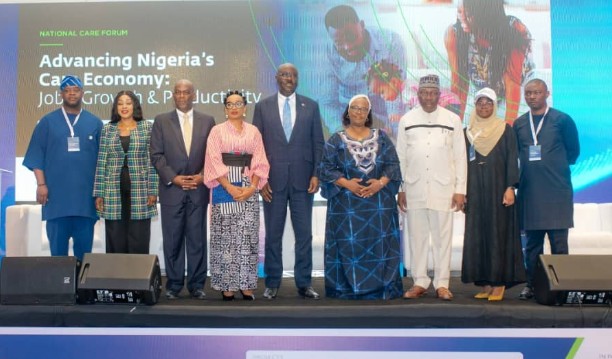
The stakeholders spoke at the World Bank Group National Care Forum, themed “Advancing Nigeria’s Care Economy: Jobs, Growth and Productivity,” held at the Marriott Hotel, Ikeja, Lagos.
Speaking during his Opening Remarks on “position care as central to women’s economic participation, children’s development, jobs, human capital and inclusive growth”, Head of Office, Nigeria, International Finance Corporation, World Bank Group, Christian Mulamula, said the care economy was critical to economic development because women continued to shoulder a disproportionate share of unpaid care work.
He explained that women spent about three times as much time as men on unpaid care activities, limiting their opportunities to secure employment, develop businesses and participate fully in economic activities.
“Care is, therefore, not just a family responsibility; it is an important part of our economic infrastructure.”
Mulamula said access to quality childcare could help parents remain productive at work, noting that 67 per cent of working parents surveyed said better childcare services would improve their productivity. He added that investment in early childhood development could generate returns of up to 30 per cent, while closing the gender employment gap could add about 22.9 billion dollars to Nigeria’s economy annually.
“The children we care for today are Nigeria’s workforce tomorrow.”
In his presentation titled “The Case for Care in Nigeria: Why Do We Need Childcare?”, Senior Economist, Gender Innovation Lab, World Bank Group, Ayodele Fashogbon, said women spent considerably more time caring for children than men, with women spending an average of 76 minutes daily on childcare compared with 13 minutes for men. Women aged 25 to 39 also spent about 194 minutes on care activities daily, against 44 minutes for men.
He said the responsibility affected women’s employment prospects, with their employment declining by 36 per cent after the arrival of a child below six years, while men’s employment increased by 10 per cent. “The figures show a significant difference in the amount of time men and women spend caring for children.”
Fashogbon noted that about 33 million Nigerian children between zero and five years lacked access to centre-based childcare, while the cost of childcare could account for about three per cent of the annual minimum wage. He added that 75 per cent of childcare providers faced difficulties accessing finance, while only five per cent of private employers invested in childcare support for their workers.
He said expanding access to childcare would improve women’s employment and income, strengthen household earnings and support children’s development.
“The question is no longer whether Nigeria can afford to invest in childcare. The question is whether we can afford not to invest in it.”
Delivering his welcome address and “Highlighting the role of Lagos State in using policy, finance, and partnerships, to create enabling conditions for greater private-sector participation and investment in sustainable care solutions and child development”, Lagos State Governor, Babajide Sanwo-Olu, who represented by the Commissioner for Finance, Mr Abayomi Oluyomi, said childcare should be recognised as infrastructure that supports economic participation.

Mr Oluyomi added that government had a responsibility to support vulnerable families while strengthening regulation, safety standards and financing models for care services.
“If we want to strengthen small businesses and expand women’s participation in the economy, we must begin to treat childcare and other essential care services as part of the infrastructure that supports economic growth.”
At the federal level, the Minister of Women Affairs and Social Development, Hajiya Imaan Sulaiman-Ibrahim, who was represented by Andrew Ali Madogo, in her address on, “Frame care as a national priority for women’s economic participation, families, and Nigeria’s development”, said the Federal Executive Council had approved three national instruments on October 28, 2026, to strengthen the country’s care and protection systems.
They include the National Care Policy and Implementation Plan 2026-2030, the National Programme on Violence Against Children, and the National Policy on Mental Health and Ageing Management 2026-2030.
Madogo said the National Care Policy covered childcare, early childhood development, elderly care, disability support, care workers and family-friendly workplaces. He added that the Federal Government was developing a proposed National Care Fund and an executive bill in collaboration with the Ministry of Justice and other partners to provide sustainable financing for the sector.
“The care economy will be integral to Nigeria’s national ambition of building a one-trillion-dollar economy.”
He said the government was also working with development partners, including UN Women, UNICEF, the World Bank and CARE Africa, to strengthen the sector and improve the conditions of care workers.
The panel session, titled “From Policy to Practice: Advancing Quality Childcare and Child Development in Nigeria,” examined how national care policies could be translated into practical action across the states.
Speaking during the session, Andrew Ali Madogo, highlighted the need to map existing childcare centres and improve data collection to establish a clearer picture of the sector. He said reliable information would help government identify gaps, plan interventions and monitor progress in expanding access to quality care.
The Director of Special Duties, Federal Ministry of Budget and Economic Planning, Dr Gloria Ahmed, said effective implementation of the National Care Policy required proper budgeting, clear institutional responsibilities and coordination among government agencies. She called for care services to be integrated into national and state development plans, with budgetary provisions translating into actual services.
Ahmed also identified public-private partnerships as important for mobilising resources and expanding childcare infrastructure. She highlighted the Gender-Responsive Planning and Budgeting Framework as a tool for ensuring that government spending addressed the needs of women, men and vulnerable groups.
Director, National Board for Technical Education and IDEAS Project, Engineer Suleiman Yusuf, called for professional standards and structured training to improve childcare services and strengthen the skills of care workers. He said National Occupational Standards would provide a framework for training, assessment and certification.
UN Women Country Representative, Beatrice Enyong, drew attention to the unequal distribution of unpaid care work, which places a heavier burden on women, while paid care occupations are often dominated by men.
She called for improved access to finance for women-owned care businesses, gender-responsive budgeting and investment in labour-saving technologies. Enyong also stressed the need to change social attitudes to encourage men to take a more active role in household responsibilities, while calling for better mapping of care services, budget accountability and stronger monitoring systems.
The stakeholders urged governments, employers, financial institutions and development partners to move beyond policy commitments and invest in practical solutions that would reduce the burden of unpaid care work, improve women’s economic participation and strengthen Nigeria’s productivity.