By Kazeem Waris
Gombe State has emerged as Nigeria’s best-performing state in the implementation of school improvement projects under the Adolescent Girls Initiative for Learning and Empowerment (AGILE), beating 10 other participating states and securing national recognition for its project management model.
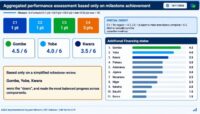
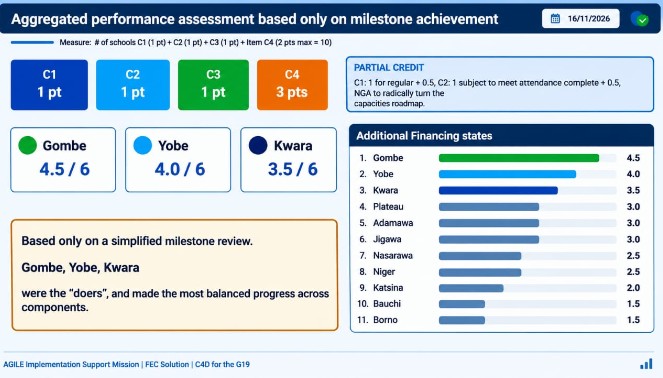
The state scored 4.5 out of six points, representing 75 per cent, in an implementation milestone review involving 11 states benefiting from the AGILE Project’s Additional Financing.
Yobe and Kwara states came second and third with 4.0 and 3.5 points respectively.
The recognition was announced during the AGILE Implementation Support Mission, which identified Gombe, Yobe and Kwara as the three states recording the most balanced progress across the assessed implementation components.
In a major endorsement of its performance, Gombe’s project management model and implementation structure have also been adopted for replication across the country.
The development highlights the state’s approach to coordinating educational interventions, managing projects and translating development funding into improved learning infrastructure, particularly for adolescent girls.
According to the Federal Government’s AGILE National Dashboard, 544 schools in Gombe are currently captured under the programme’s mapped coverage, reflecting the reach of the intervention across the state.
Beyond the national recognition, the Gombe State Government has introduced several interventions aimed at improving school enrolment, attendance and retention, particularly among girls from vulnerable households.
Recently, the state flagged off the distribution of Automated Teller Machine (ATM) cards to beneficiaries under the AGILE Conditional Cash Transfer Scheme, designed to ease the financial difficulties confronting disadvantaged families and encourage parents to keep their adolescent girls in school.
The state has also implemented a N13.5 billion School Improvement Grant covering 442 secondary schools, alongside conditional cash transfers and scholarship interventions benefiting thousands of students, predominantly girls.
The investments are aimed at addressing infrastructure gaps, reducing the financial burden on vulnerable households and creating a more conducive environment for teaching and learning in public secondary schools.
In another major intervention, the government, through the AGILE Project, has commenced construction of 26 new public secondary schools across the state’s three senatorial districts.
The projects comprise 13 junior and 13 senior secondary schools, with each designed to include modern laboratory facilities and essential furniture to improve practical learning and access to quality education.
The adoption of Gombe’s implementation framework is expected to provide other participating states with an opportunity to draw from its project coordination, administrative arrangements and delivery strategies.
The recognition also reinforces the importance of effective project management, accountability and sustained government investment in translating education policies into measurable improvements in school access and learning conditions.
For Gombe, the achievement provides further recognition of its efforts to expand secondary education, address gender disparities and improve educational opportunities for adolescent girls, particularly those from disadvantaged communities.