By Blessing Elo Oghene
The Federal Capital Territory Administration (FCTA) has upgraded 20 primary healthcare centres across the territory, announcing that emergency ambulance response for pregnant women has been reduced to less than four minutes.
The Mandate Secretary of the FCT Health Services and Environment Secretariat, Dr Adedolapo Fasawe, disclosed this on Monday in Abuja during the inauguration of the renovated and upgraded Owner-Occupier Model Primary Health Centre in Kubwa.
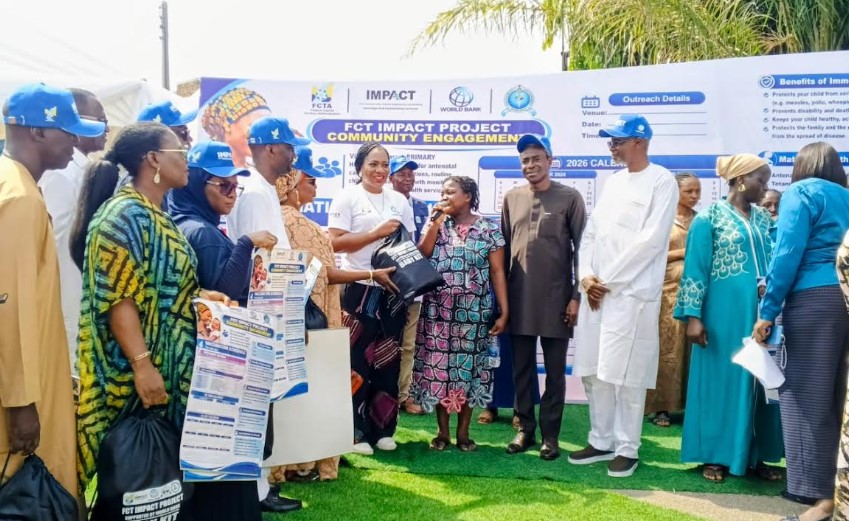
She explained that the renovation and upgrade were undertaken under the World Bank-supported Immunisation Plus and Malaria Progress by Accelerating Coverage and Transforming Services (IMPACT) project.
To demonstrate the effectiveness of the emergency response system, Fasawe asked a pregnant woman to call one of the designated emergency numbers, after which an ambulance arrived at the location in less than four minutes.
She said the emergency service was strengthened through the FCT Emergency Medical Services and Ambulance System (FEMSAS), which operates round the clock at no cost to beneficiaries.
According to her, the system also involves local transport operators who assist in conveying pregnant women during emergencies.
Fasawe noted that the intervention went beyond renovating healthcare facilities, explaining that staff accommodation had been constructed, modern medical equipment provided and solar-powered systems installed to ensure uninterrupted electricity and 24-hour service delivery.
She described primary healthcare centres as the first point of contact for many residents, stressing their importance in reducing preventable deaths and improving access to quality healthcare.
“The PHC is usually the first port of call for most residents. This is fundamental to improving health outcomes, reducing preventable deaths, and achieving universal health coverage.
“This is just one of 20 primary healthcare centres across different communities in the FCT that were upgraded under the IMPACT project,” she said.
On healthcare affordability, the Mandate Secretary disclosed that at least 1,000 vulnerable residents were being enrolled free of charge into the FCT Health Insurance Scheme under the Basic Health Care Provision Fund.
She explained that the beneficiaries would enjoy one year of free medical services in accredited public and private hospitals.
Fasawe also commended the FCT Minister, Nyesom Wike, for road construction and rehabilitation projects across satellite towns, noting that the improved road network had significantly reduced travel time to healthcare facilities.
She said the administration’s healthcare strategy was built around three major pillars: access, affordability and quality, in line with President Bola Tinubu’s Renewed Hope Agenda.
The Mandate Secretary urged traditional rulers and community leaders to take responsibility for protecting the upgraded facilities, monitoring service delivery and ensuring that residents were not charged for services meant to be free.
“Healthcare should not be a luxury reserved for a few. Quality healthcare is your fundamental human right,” she said.
Also speaking, the Executive Secretary of the FCT Primary Health Care Board, Dr Dan Gadzama, said the Federal Government initiative commenced in 2021, with an initial completion deadline of December 2025.
He explained that the project had immunisation and malaria components but that the FCT was initially excluded from the immunisation component.
Gadzama said the situation changed following Fasawe’s intervention and sustained engagement with the World Bank, which eventually secured the territory’s inclusion in the programme.
According to him, the FCT signed its Subsidiary Loan Agreement (SLA) with the bank in February 2025, while subsequent disbursements in September and advocacy efforts led to a one-year extension of the project, moving its completion deadline to December 2026.
He said the major objective of the programme was to reduce maternal and under-five mortality through improved access to healthcare and the removal of financial barriers affecting vulnerable residents.
Gadzama disclosed that 20 primary healthcare centres across the six area councils were selected through data-driven gap analysis, renovated and fully equipped.
He added that the board procured more than 70 laptops and tablets to improve data submission into the National Health Management Information System and trained over 250 healthcare workers.
The board also procured and distributed Mama Kits containing essential delivery materials to reduce the financial burden on pregnant women and encourage them to seek healthcare services.
He further disclosed that collaborations had been established with community leaders, primary healthcare officials and security agencies to ensure uninterrupted service delivery, particularly in areas facing security challenges.
The World Bank’s Task Team Leader for the IMPACT project, Dr Onoriode Ezire, commended the FCTA for the quality and pace of implementation, noting that some states that joined the programme earlier had yet to complete similar projects.
“Some states that started this two years ago have not completed their PHCs, and they are not even up to your standard. It shows the type of leadership we have here, the commitment, and the work being done,” Ezire said.
Similarly, the Senior Special Assistant to the President on Community Engagement (North-Central), Dr Abiodun Essiet, praised the FCTA for translating federal healthcare policies into tangible benefits for residents.
Essiet disclosed that since 2023, the Federal Government had extended health insurance coverage to more than 16 million Nigerians and invested over ₦235 billion in upgrading primary healthcare centres nationwide.
She added that the government had also introduced free Caesarean sections and subsidised dialysis services.
In his remarks, the Village Head of Usuma Ward, Kubwa, Chief Beje Tazodayi, appreciated the FCTA for transforming the previously dilapidated health facility into a modern medical centre.
He, however, appealed to the administration to absorb volunteer healthcare workers into the formal health system.