By Ademola Ade
The Nigerian Medical Association (NMA) on Monday called on the Federal Government to provide doctors with internationally competitive remuneration, improved working conditions and safer workplaces to stem the growing exodus of medical professionals from the country.
The association warned that excessive workloads, occupational stress, inadequate healthcare infrastructure, poor remuneration, delayed entitlements and declining welfare were undermining physicians’ wellbeing and threatening the future of medical practice in Nigeria.
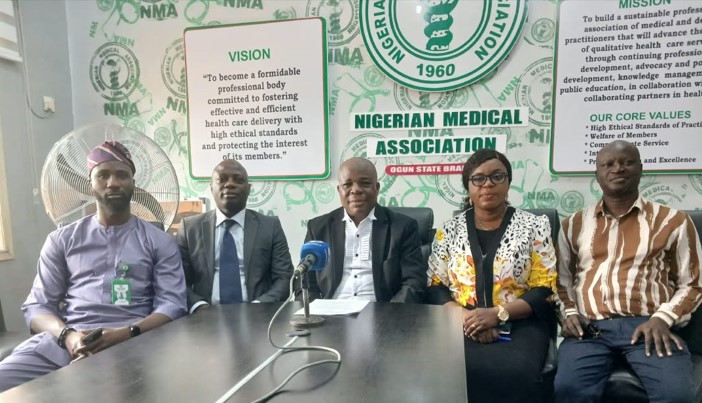
The Chairman of the NMA in Ogun State, Dr Sunday Enimola, made the call at a press conference in Abeokuta as part of activities marking the 2026 Physicians’ Week, themed: “Securing the Future of Medicine in Nigeria.”
Enimola said the country must move beyond lamenting the continued migration of doctors and implement practical policies that would encourage medical professionals to remain in Nigeria and build rewarding careers.
According to him, appeals to patriotism alone would not reverse the trend without deliberate efforts to address the conditions under which doctors work and live.
“Patriotism should be supported by decent working conditions, professional dignity, security, competitive remuneration, opportunities for career development and a health system in which doctors can see a future for themselves and their families,” he said.
He urged the government and hospital chief executives to prioritise physicians’ welfare, occupational safety and professional development, stressing that the survival of Nigeria’s healthcare system depended largely on the wellbeing and retention of its medical workforce.
The NMA chairman maintained that retaining doctors required a comprehensive approach that addressed not only salaries but also the broader professional and personal challenges confronting medical practitioners.
He argued that inadequate working conditions, limited career development opportunities and persistent welfare concerns could discourage doctors from remaining in the country, particularly when better professional prospects were available elsewhere.
Enimola also called for a fundamental shift in the culture of medical practice, which, he said, often expected doctors to sacrifice their personal wellbeing in the service of patients.
He described the longstanding expectation that physicians should continue working despite exhaustion and neglect their own health while fulfilling their professional responsibilities as unsustainable.
According to him, doctors cannot indefinitely provide quality healthcare when they are physically exhausted, emotionally depleted and exposed to chronic stress.
“A physician who is physically exhausted, emotionally depleted and chronically stressed cannot indefinitely deliver the quality of care patients deserve,” he said.
He called for greater awareness of the mental and physical health challenges confronting medical professionals, urging doctors to embrace preventive healthcare, regular medical examinations, healthy lifestyles, adequate rest and confidential professional and psychological support.
The association also advocated work environments where doctors could take leave without guilt, rest without shame and seek assistance without fear of being perceived as weak.
Enimola said physicians’ wellbeing should be treated as an essential component of patient safety and overall health system performance rather than a personal concern left entirely to individual practitioners.
He identified excessive working hours, occupational stress, unsafe working environments, inadequate staffing, violence against healthcare workers, poor remuneration and delayed entitlements as some of the factors exposing doctors to physical and psychological risks.
He warned that Nigeria could not afford to continue losing medical professionals to preventable causes while they were still actively engaged in saving lives.
The NMA chairman stressed that addressing these challenges would require sustained collaboration among the Federal Government, state governments, hospital administrators and other stakeholders in the health sector.
He further called for increased investment in healthcare infrastructure, improved access to essential medical equipment and better staffing levels to reduce the pressure on doctors working in understaffed and poorly equipped facilities.
Enimola also condemned threats, intimidation, assaults and other forms of violence against healthcare workers, insisting that hospitals must provide safe environments for both medical professionals and patients.
“Hospitals must be places of healing, not theatres of violence,” he said.
He stressed that doctors could not deliver compassionate and effective healthcare while constantly worrying about their personal safety.
According to him, protecting healthcare workers should be a priority for hospital management and relevant security agencies, particularly in facilities where tensions between patients, relatives and medical personnel could escalate into violence.
Among the measures he identified as necessary to protect physicians were safer workplaces, adequate security, appropriate medical equipment, functional healthcare infrastructure, decent accommodation where necessary and improved conditions of service.
“The safety of doctors is not negotiable. And when doctors are safe, patients are safer,” he added.
Beyond welfare and workplace safety, Enimola called for greater investment in emerging technologies, warning that Nigeria must prepare its healthcare system for the rapid transformation taking place in medical practice globally.
He identified artificial intelligence (AI), telemedicine, electronic medical records, precision medicine, digital diagnostics, remote patient monitoring, robotics and genomics as innovations increasingly reshaping healthcare delivery.
According to him, Nigeria could not afford to remain on the margins of the technological revolution transforming the health sector.
He, however, cautioned that technology should complement medical professionals rather than undermine the human relationships at the heart of healthcare.
“Technology must serve the doctor and the patient, not replace the humanity at the heart of medicine,” he said.
He explained that future physicians would require skills beyond traditional clinical knowledge, including data analysis, artificial intelligence, digital health, cybersecurity, research methodology, health economics, communication, leadership and interdisciplinary collaboration.
He consequently urged medical schools to review their curricula to ensure that medical students and young doctors were adequately prepared for the changing demands of healthcare delivery.
The NMA chairman also called for increased investment in undergraduate and postgraduate medical education, improved teaching hospitals, stronger research capacity and better support for academic physicians.
He warned against compromising the standards of medical training, maintaining that the quality of future healthcare would depend largely on the quality of education provided to medical students and young doctors.
“The quality of tomorrow’s healthcare depends on the quality of today’s medical education. We cannot afford to compromise standards,” he said.
While advocating the preservation of high training standards, Enimola called for the adoption of modern educational methods, including simulation, digital learning, virtual collaboration, competency-based education and interdisciplinary training.
He said medical education must equip future physicians with the ability to think critically, adapt to emerging challenges and pursue continuous professional development throughout their careers.
Enimola further emphasised the need to strengthen research and innovation in Nigeria’s medical institutions, noting that investment in medical education and professional development would help prepare doctors to respond to evolving healthcare needs.
He maintained that a sustainable health system required not only well-trained physicians but also an enabling environment where they could apply their knowledge, access modern tools and pursue professional advancement.
The NMA chairman reiterated that improving remuneration, strengthening occupational safety, expanding career development opportunities and modernising medical education were critical to securing the future of medicine in Nigeria.
He urged the government and other stakeholders to translate commitments to healthcare development into concrete measures that would improve the welfare of doctors, protect healthcare workers and strengthen service delivery.
According to him, creating a health system that values its medical workforce would benefit both practitioners and the millions of Nigerians who depend on them for essential healthcare services.
He said the future of medicine in the country would depend largely on the willingness of stakeholders to invest in doctors, improve working conditions and build a healthcare system capable of meeting present and future challenges.