By Desire Uzochukwu
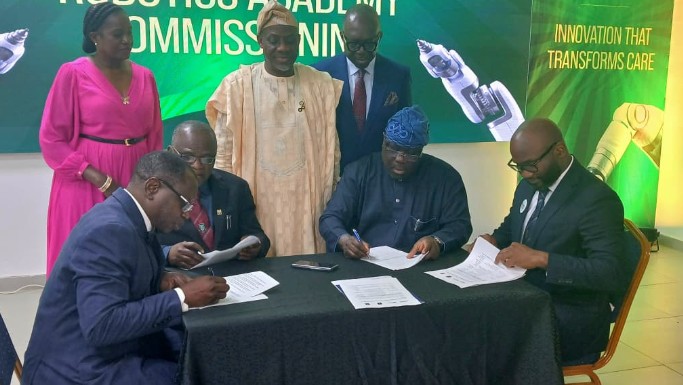
Nigeria’s drive to strengthen specialist healthcare has received a boost with the launch of the RHV–ROBOMED Robotic Academy, which aims to train 400 specialists within two years and expand the country’s capacity to deliver advanced surgical care.
Established by Redeemers Health Village (RHV) in partnership with ROBOMED and other medical and academic institutions, the academy is designed to build a skilled workforce for robotic-assisted surgery through structured postgraduate education, hands-on training and technical capacity development.
The initiative seeks to address a critical challenge in adopting advanced medical technology: ensuring that hospitals have not only sophisticated equipment but also adequately trained surgeons, nurses, biomedical engineers and other professionals to operate and maintain it.
Speaking at the launch, the Chief Executive Officer of Redeemers Health Village, Dr Adedamola Dada, said the overarching goal was to make world-class healthcare available and affordable to Nigerians, reducing the need to travel abroad for specialised treatment.
“Our mandate is to produce world-class healthcare services, such that nobody needs to leave this country,” Dada said, emphasising that quality services must also be accessible to patients.
Dada disclosed that RHV and its partners had invested in two robotic surgical systems valued at approximately $4 million. One system is designated for clinical services, while the other will support training.
He said the arrangement would allow the academy to combine practical instruction with clinical experience, creating a pipeline of professionals capable of supporting robotic surgery in Nigeria.
The programme will cover surgeons in specialties including urology, general surgery and gynaecology, as well as nurses, biomedical engineers, product specialists and operating-theatre personnel.
According to Dada, the training initiative involves collaboration with the National Postgraduate Medical College of Nigeria and Redeemer’s University, with the institutions contributing to specialist education, professional certification and workforce development.
He stressed that investing in advanced medical equipment without developing the personnel required to operate and maintain it would undermine the sustainability of the technology.
“We are going to be training nurses,” Dada said, adding that the initiative would also prepare technical personnel to support the safe and effective operation of robotic systems.
Building local capacity
Dada said the academy builds on RHV’s existing robotic surgery programme, which he disclosed had recorded about 40 robotic surgical cases in collaboration with its partners.
He also said the institution had performed what he described as West Africa’s first tele-robotic surgery approximately four weeks before the launch, followed by two additional procedures the day before his address.
Tele-robotic surgery uses robotic technology to enable a surgeon to operate remotely, subject to suitable equipment, connectivity, clinical support and safety arrangements.
Dada said developing local expertise would help expand access to complex procedures, reduce medical tourism and retain skilled professionals who might otherwise seek opportunities abroad.
To illustrate the potential financial implications, he compared the reported cost of a robotic surgical procedure in the United States, which he said could reach $75,000, with the most expensive procedure at RHV, which he put at between ₦20 million and ₦25 million.
He maintained that the project was driven primarily by public benefit rather than profit.
“The persistent question they always ask me is how many Nigerians have benefited from this service,” he said, referring to the commitment of the organisation’s leadership and partners.
Alausa backs specialist training
The Minister of Education, Dr Tunji Alausa, described the academy as an important investment in medical education and specialist workforce development.
He commended the founders and their partners for bringing together healthcare institutions, universities and professional bodies to advance specialist training.
Alausa also urged Nigerian professionals in the diaspora to contribute their expertise to national development, stressing the need to create opportunities for skilled professionals to return home and strengthen local institutions.
He said collaboration between educational institutions and clinical professionals could expand specialist training and improve healthcare delivery.
Technology must serve patients
The Vice-Chancellor of Redeemer’s University, Professor Shedrack Akindele, described the academy as a significant milestone in medical innovation and specialist surgical training in Nigeria and West Africa.
He said the success of the initiative should be measured not simply by the equipment installed but by the competence of its graduates and the benefits delivered to patients.
“The true success of this academy will be measured not simply by the equipment it employs or the number of professional internships, but by the competence of its graduates, its contribution to patient safety, and its impact on the quality and accessibility of surgical care,” Akindele said.
He urged the partners to prioritise rigorous training, ethical practice, research, continuous professional development and international collaboration.
Professor Anthony Ikefuna, representing the National Postgraduate Medical College of Nigeria, also welcomed the initiative, describing it as a step towards integrating digital technology into healthcare delivery.
He reaffirmed the college’s commitment to specialist training, saying the partnership could strengthen local expertise and help reduce the need for Nigerians to seek treatment abroad.
Ossai calls for wider healthcare reforms
Enugu State Deputy Governor, Dr Ifeanyi Ossai, said investments in specialist healthcare could help address inequalities that prevent many Nigerians from accessing advanced treatment overseas.
However, he cautioned that specialist facilities must be supported by stronger primary healthcare services and greater public confidence in local hospitals.
Ossai questioned why tertiary hospitals continued to receive patients with conditions that could ordinarily be managed at lower levels of care.
He called for coordinated efforts by governments, healthcare professionals and the private sector to strengthen primary healthcare, improve health insurance and ensure patients receive appropriate treatment.
The Vice-Chairman of the Board of Redeemers Health Village, Dr Olufemi Adeyemi, also emphasised knowledge transfer and professional development, saying academic institutions had a responsibility to pass expertise on to future generations.
With a target of 400 specialists within two years, the RHV–ROBOMED Academy aims to strengthen Nigeria’s capacity in robotic surgery and other advanced medical technologies.
Its long-term impact will depend on the quality of training, sustained investment, equipment maintenance and the ability to make advanced surgical care affordable and accessible to Nigerians.