By Joyce Ekeh
The Allied Peoples Movement (APM) has said it will not prioritise investigating President Bola Tinubu’s administration if elected into power, insisting that Nigeria’s worsening challenges require urgent intervention rather than political vendettas.
The party’s vice-presidential candidate, Lawal Daura, said the country was in an emergency situation and needed immediate action to address its economic, security and structural problems.
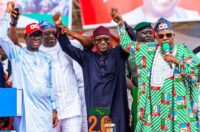
Daura, who is the running mate to Oyo State Governor and APM presidential candidate, Seyi Makinde, said an administration led by the party would focus on stopping what he described as the country’s bleeding instead of expending time and resources probing alleged wrongdoing by the outgoing government.
Speaking on Politics Today, a Channels Television programme on Wednesday, the former Director-General of the Department of State Services (DSS) said the party’s proposed national reset was informed by widespread public disillusionment and the failure of successive national conferences to resolve Nigeria’s fundamental problems.
Asked whether an APM government would investigate the Tinubu administration, Daura said:
“No, it is not a question of probing. But I don’t think any serious nation that has plenty of problems will start to bother about investigating a criminal government. The country is bleeding, and we need to stop the hemorrhage. We are in an emergency Intensive Care Unit, ICU. There is no way somebody can start looking to see who has stolen what, who has done what.”
Explaining the party’s proposed national reset, Daura said Nigeria’s diverse ethnic and cultural composition required a governance structure that accommodated the interests of its constituent nationalities.
He argued that the country’s founding vision at independence was based on federalism, which he said was intended to reduce tensions arising from its multi-ethnic character.
According to him, the proposed reset would involve bringing elected representatives, government officials and other individuals considered qualified on merit into an inclusive national conversation on the country’s future.
He said: “I think the citizens of Nigeria are disillusioned. The whole idea of resetting emanated from the fact that the configuration of Nigeria, having been a populous country, and then of course having multifaceted cultural values, is to ensure that many nationalities come to be under one nation called Nigeria.
“Like you must have heard during the unveiling of our manifesto, we spoke about the vision of the founding fathers of this nation and that at independence, agreed that this country should be a federation. This will reduce the tension that is likely to accompany the multi-ethnicity that we have in this country.
“What we actually mean by resetting is that there are so many issues that are affecting individuals and the collective of Nigerians. We feel if you just set up a body to discuss them, those who might participate in the discussion might not really be actors in government. But it will be better if we are able to get the actors that are in government, elected representatives of the people, and then of course those that might have been found based on merits to also be in government, we will now start the conversation all over again.
“That was why we said it is going to be an all-inclusive government and a transitional one at that. The transition is based on the fact that whatever is going to be discussed and agreed is going to now form the basis for the next government, and of course subsequent governments. By the way, if all people are represented, inclusiveness would mean everybody is represented in the government.”
On the country’s worsening security situation, the former DSS chief accused political leaders of over-politicising security management, arguing that addressing insecurity required professional competence, intelligence and merit-based appointments rather than simply increasing military hardware or budgetary allocations.
Daura maintained that security went beyond the deployment of weapons and the amount of money committed to the sector, stressing the importance of effective intelligence gathering and the proper utilisation of security personnel.
He said: “Security has been too politicised by the political leaders. They might not know or they may be doing it inadvertently, but I think if you really want to avoid making a very huge mistake, especially as a part of the safety, security and progress of a nation, then ask those who don’t.
“When we imagine that problem, like I said elsewhere, it is not really the number of arms or armoury or whatever arsenal you put that brings security. It is not also maybe the amount of money you pump into security that will bring about security. And then of course, when I speak about the general security of a nation, it involves so many things. People must be placed based purely on merit. Intelligence is there. The intelligence community is working so hard.”
Daura also questioned international assessments suggesting that Nigeria’s economy was improving, arguing that such reports did not necessarily reflect the economic realities confronting ordinary citizens.
He expressed reservations about the influence of global politics on assessments by international financial institutions, particularly the International Monetary Fund (IMF) and the World Bank.
According to him, Nigerians should judge economic performance by tangible improvements in their living conditions rather than figures and assessments issued by international organisations.
He said: “We should not lose sight of the fact that there is global politics in this. There is a lot of politics there. Therefore, when you are doing what they want, they always end up praising you. But at the end of the day, there is no country today in the world that has really relied on them, guided by them, and fully following what they say, that has really gone out of …
“Also, the same thing is happening. There is nothing tangible to show. So claims are different from seeing or being, feeling it, or seeing it, or even touching it. It is not an abstract thing. Therefore, whatever language the IMF or the World Bank may say, I think we in Nigeria, we know better. We are not feeling what they are saying, we are not seeing what they are saying and we are not in any way getting any idea where they get their figures, or where they get their conclusion, or their inference.”
The APM candidate’s comments come as the party outlines its proposed approach to restructuring governance, addressing insecurity and tackling economic challenges through what it describes as an inclusive transitional administration.
Daura’s remarks also place the party’s proposed national reset at the centre of its political message, with the candidate arguing that addressing Nigeria’s immediate challenges should take precedence over investigations into the outgoing administration.