By Editor
A child who struggles to pronounce simple words, an adult whose speech becomes slurred after a stroke, or someone who suddenly finds it difficult to express thoughts may be experiencing more than an ordinary communication challenge. Behind these difficulties could be a speech, language or neurological disorder requiring specialised care.
For millions of people living with communication difficulties, speech therapy offers an opportunity to regain confidence, improve relationships and participate more fully in everyday life.
Often misunderstood as treatment exclusively for children who have difficulty speaking, speech therapy is a specialised healthcare service that supports people of all ages to communicate, understand language, use their voices and, in some cases, swallow safely.
Also known as speech-language pathology or speech-language therapy, the treatment is delivered by trained professionals called speech-language pathologists (SLPs), who assess individual challenges and develop personalised treatment plans.
According to the Cleveland Clinic, speech therapy helps people improve their ability to talk and use other language skills. It also supports the ability to understand what others are saying, express thoughts and feelings, and strengthen cognitive skills such as memory and problem-solving.
More than correcting pronunciation
While many people associate speech therapy with helping children pronounce difficult sounds, its scope extends far beyond correcting mispronounced words.
It addresses several conditions affecting speech, language, voice, communication and swallowing.
One of these is articulation disorder, which occurs when a person struggles to produce certain speech sounds correctly. A child, for instance, may say “wed” instead of “red” or “thith” instead of “this”.
Fluency disorders, including stuttering and cluttering, can also affect communication. Stuttering disrupts the smooth flow of speech through repeated sounds, interruptions or blocks, while cluttering involves unusually rapid or merged speech that makes communication difficult to follow.
Another condition is apraxia, a motor speech disorder in which individuals know what they want to say but struggle to coordinate the movements required to produce the words.
Dysarthria, on the other hand, occurs when the muscles responsible for speech become weak, resulting in slow, unclear or slurred speech. It may develop following a stroke or as a result of neurological conditions such as multiple sclerosis and amyotrophic lateral sclerosis.
When the brain struggles to communicate
Speech and language difficulties are not always caused by problems with the mouth or vocal organs. Sometimes, damage to the brain affects a person’s ability to understand or express language.
A condition known as aphasia, for example, can develop after a stroke or brain injury damages areas responsible for language processing.
People living with aphasia may struggle to speak, read, write or understand conversations. Some know what they want to communicate but cannot find the appropriate words, while others have difficulty understanding what people are saying.
Cognitive-communication disorders can also affect listening, attention, memory, reasoning and problem-solving, making everyday interactions challenging.
Speech therapy helps individuals work on these abilities through structured exercises and strategies designed around their specific difficulties.
It is not just about speaking
An often-overlooked area of speech therapy is swallowing.
People with dysphagia, a condition that makes swallowing difficult, may experience problems chewing food, controlling liquids in their mouths or safely swallowing meals.
The condition can increase the risk of food or liquid entering the airway.
Speech-language pathologists assess swallowing difficulties and recommend appropriate exercises, techniques and strategies to help patients eat and drink more safely.
Therapy may also address voice and resonance disorders, including persistent hoarseness, vocal strain and changes in pitch or volume. Some conditions affecting the structure of the mouth and nose, including cleft palate, can interfere with normal sound production.
How speech therapy works
Treatment begins with an assessment by a speech-language pathologist, who examines the patient’s medical history, communication abilities and, where necessary, swallowing function.
Based on the findings, the therapist develops an individual treatment programme.
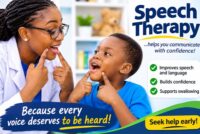
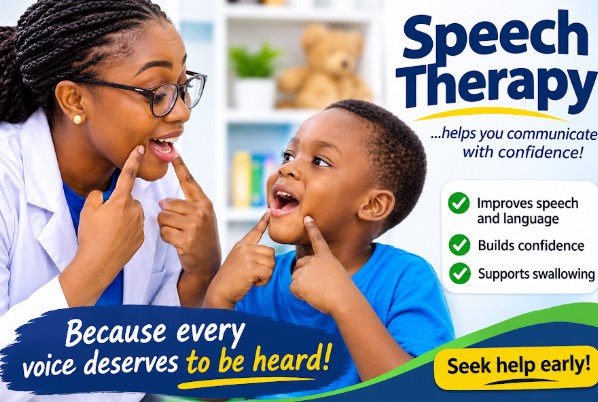
For children, sessions often involve play-based activities, language games, storytelling and exercises that encourage the development of vocabulary, sentence formation and pronunciation.
Adults may undertake exercises aimed at rebuilding communication abilities following a stroke or brain injury, strengthening coordination between the brain and mouth, or improving voice control.
Other activities include tongue and mouth exercises, facial movements, reading aloud, memory games and word puzzles.
For individuals who cannot communicate effectively through speech, therapists may introduce augmentative and alternative communication tools, including picture boards and speech-generating devices.
Treatment can take place in hospitals, clinics, schools, homes or through online sessions. Regular practice outside therapy sessions is also important, particularly for children who benefit from reinforcement by parents and caregivers.
Early intervention can make a difference
Although speech therapy is frequently associated with childhood development, there is no age limit for seeking help.
Children experiencing language delays or difficulty understanding simple instructions may benefit from early assessment and intervention.
Warning signs include speaking less frequently than expected, struggling to use words, difficulty following simple sentences and becoming easily frustrated when trying to communicate.
A healthcare provider may recommend initial screening, including a hearing assessment, before referring a child to a speech-language pathologist.
According to the Cleveland Clinic, studies have found that children who need speech therapy achieve the greatest success when treatment begins early and they practise at home with loved ones.
However, adults should not assume that communication difficulties are simply part of ageing or that treatment is no longer useful after childhood.
People who experience speech difficulties following a stroke, brain injury or neurological condition can also benefit from specialised intervention.
A journey that requires patience
Speech therapy is an established treatment that has helped millions of people improve their communication and language abilities. However, progress differs from one individual to another.
Some speech difficulties improve with age, while others require months or years of structured therapy. The duration depends on the patient’s age, the nature and severity of the condition, the underlying cause and the frequency of treatment.
Its benefits go beyond speaking clearly. Improved communication can strengthen self-esteem, increase independence, enhance social interaction and improve overall quality of life.
For children, it can support school readiness and participation in classroom activities. For adults recovering from illness or injury, it can help restore the ability to communicate needs, maintain relationships and regain some independence.
The Cleveland Clinic advised people who notice difficulties affecting their ability to speak, hear or communicate to seek medical assessment.
Ultimately, speech therapy is not simply about teaching someone to pronounce words correctly. It is about helping people connect with others, express themselves and reclaim an important part of everyday living.