By Daniel Kudayah
The Federal Government has set a target of 25,000 free cataract surgeries by the end of 2027 as part of efforts to reduce avoidable blindness and improve access to eye care across the country.
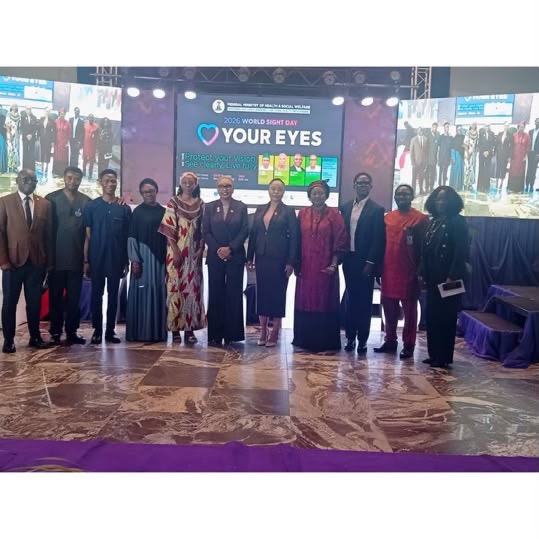
The Minister of State for Health and Social Welfare, Dr. Iziaq Adekunle Salako, disclosed this during the commemoration of the 2026 World Sight Day in Abuja.
Salako, who was represented by the Director of the E-Health Division, Dr. Doris Afam Aneke, said the initiative was being implemented under the Renewed Hope Health Connect programme in line with the Nigeria Health Sector Renewal Investment Initiative.
He described eye health as a public health and development priority, noting that poor vision affects education, productivity, independence and quality of life.
According to him, the government is integrating eye care into primary healthcare services to ensure that more Nigerians can access treatment without travelling long distances or facing financial barriers.
The minister identified cataracts as a major cause of avoidable blindness, adding that the planned surgeries would help restore sight and independence to thousands of Nigerians.
He said more than 3,000 health workers had been trained across 16 states, while over 1,400 primary healthcare centres had been activated to provide basic eye care services.
Salako added that more than 1.5 million pairs of reading spectacles had been distributed across 16 states under the Effective Spectacle Coverage Initiative Nigeria, also known as Jajibola 2.0.
He said preparations were underway to extend the programme to 10 additional states, while more than 1.5 million school-age children had been screened for visual problems under the School Eye Health Programme.
The government is also establishing four vision centres in secondary healthcare facilities in Enugu, Edo, Sokoto and Nasarawa states to strengthen access to specialised eye care.
The minister urged Nigerians to prioritise regular eye examinations, seek early treatment for vision problems and adopt healthy practices to protect their sight.
Earlier, the Permanent Secretary of the ministry, Daju Kachollom S., represented by the National Coordinator of the National Eye, Ear and Sensory Functions Health Programme, Dr. Oteri Okolo, highlighted the development of Nigeria’s first Comprehensive National Eye Health Policy, ratified by all 36 states and the Federal Capital Territory.
She also cited the National Strategic Eye Health Plan 2024–2028 as part of efforts to strengthen eye health services nationwide.
Development partners at the event called for sustained investment in prevention, early detection, treatment and rehabilitation, with particular attention to children, women, persons with disabilities and underserved communities.